Caterpillar Identification: The Easy Guide

Caterpillar identification can be tricky, but it becomes easier when you focus on key features. Look at the caterpillar’s color, markings, size, and what it’s eating. Observe its body shape, presence of hairs or spines, and the number of prolegs. Knowing the plant it’s feeding on and its location also narrows down the possibilities!
Have you ever spotted a fascinating caterpillar in your garden and wondered what it would turn into? Identifying caterpillars can feel like a mystery. There are so many shapes, sizes, and colors! It can be frustrating when you want to know more about these little creatures. But don’t worry! With a few simple steps, you can become a caterpillar detective.
This guide will help you identify caterpillars by observing their unique characteristics. We’ll explore their colors, markings, and the plants they love to munch on. Get ready to uncover the secrets of these amazing insects and discover the butterflies or moths they’ll become! Let’s begin our caterpillar adventure!
Why Caterpillar Identification Matters

Identifying caterpillars is more than just a fun activity. It’s important for a few key reasons:
- Gardening: Knowing which caterpillars are munching on your plants helps you protect your garden. Some caterpillars are beneficial, while others can cause damage.
- Conservation: Many butterfly and moth species are declining. Identifying caterpillars helps us understand their needs and protect their habitats.
- Learning: Caterpillar identification connects you to the natural world. It encourages you to observe and appreciate the incredible diversity of life around us.
Key Features for Caterpillar Identification
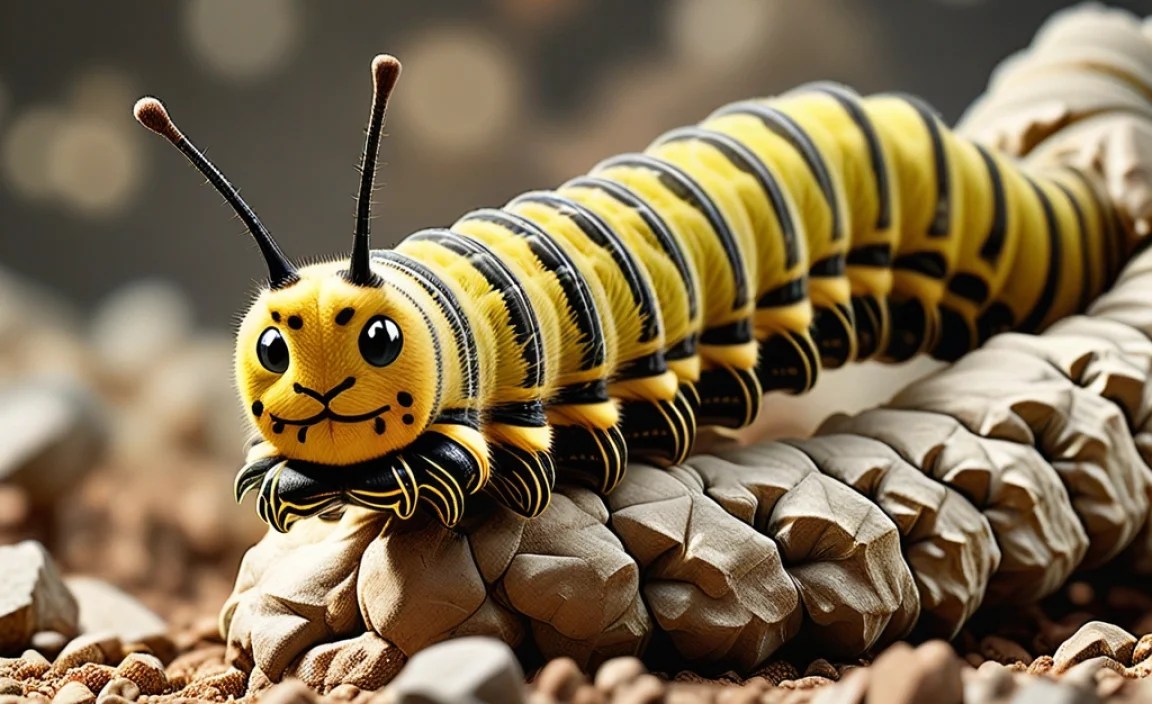
To identify caterpillars, focus on these key features:
- Color and markings
- Size and shape
- Hair or spines
- Food source
- Location
Let’s explore each of these in more detail.
Step 1: Observe Color and Markings

Caterpillars come in a rainbow of colors and patterns. These can be helpful clues to their identity.
- Color: Note the caterpillar’s primary color. Is it green, brown, black, or something else?
- Stripes: Look for stripes running lengthwise or crosswise on the body. How many stripes are there, and what colors are they?
- Spots: Are there any spots? What color are they, and where are they located?
- Horns or knobs: Some caterpillars have colorful horns or knobs on their heads or bodies.
Example: The Monarch caterpillar has distinctive black, yellow, and white stripes. This makes it easy to identify.
Step 2: Note Size and Shape
Caterpillars vary greatly in size and shape. These features can help narrow down your search.
- Size: How long is the caterpillar? Is it tiny or quite large?
- Shape: Is the body cylindrical, flattened, or humped?
- Head: Is the head capsule large or small relative to the body? Does it have any distinctive features?
- Prolegs: Count the number of prolegs (the fleshy legs in the middle of the body). Most caterpillars have five pairs, but some have fewer.
Example: Swallowtail caterpillars often have a thickened thorax (the area behind the head) and can be quite large.
Step 3: Check for Hair or Spines
Some caterpillars are smooth, while others are covered in hair or spines. This is an important identification clue, but be careful! Some hairy or spiny caterpillars can cause skin irritation.
- Hair: Is the caterpillar covered in short fuzz, long bristles, or tufts of hair? Are the hairs all the same length, or are some longer than others?
- Spines: Does the caterpillar have spines or bristles? Are they branched or unbranched? Are they located all over the body, or only in certain areas?
Caution: Avoid touching hairy or spiny caterpillars with bare hands. Use a stick or wear gloves to observe them closely. The Puss caterpillar, for example, has venomous spines that can cause a painful sting.
Here’s a table summarizing the different types of hairs and spines you might see on caterpillars:
| Type | Description | Example |
|---|---|---|
| Setae | Simple, hair-like structures | Many common caterpillars |
| Bristles | Stiff, spine-like hairs | Spiny Elm Caterpillar |
| Scoli | Fleshy projections with spines | Buck Moth Caterpillar |
| Tubercles | Small, raised bumps with hairs or spines | Mourning Cloak Caterpillar |
Step 4: Identify the Food Source
Caterpillars are picky eaters. Most species feed on only a few specific types of plants. Knowing what a caterpillar is eating can greatly narrow down the possibilities.
- Plant Type: Note the type of plant the caterpillar is feeding on. Is it a tree, shrub, vine, or herb? What kind of leaves does it have?
- Feeding Pattern: How is the caterpillar feeding? Is it chewing holes in the leaves, mining inside the leaves, or eating the edges?
Example: Monarch caterpillars feed exclusively on milkweed. If you find a caterpillar on a milkweed plant, it’s likely a Monarch.
Step 5: Consider the Location
The geographic location where you find the caterpillar can also provide clues. Different species are found in different regions.
- Region: Note the state or region where you found the caterpillar.
- Habitat: What type of habitat is it in? Is it in a forest, field, garden, or wetland?
Use online resources or field guides specific to your region to help narrow down your search. The Peterson Field Guide to Eastern Butterflies is a great resource for identifying caterpillars in the eastern United States.
Step 6: Use Online Resources and Field Guides
Several online resources and field guides can help you identify caterpillars.
- BugGuide.net: This website has a vast collection of photos and information about insects, including caterpillars.
- iNaturalist: This citizen science platform allows you to upload photos of caterpillars and get help identifying them from other users.
- Field Guides: Look for field guides specific to your region, such as “Caterpillars of Eastern North America” by David L. Wagner.
Step 7: Observe Caterpillar Behavior
Sometimes, observing a caterpillar’s behavior can provide additional clues to its identity.
- Feeding Behavior: How does the caterpillar eat? Does it chew leaves from the edge, or does it create holes in the middle?
- Movement: How does the caterpillar move? Does it crawl slowly or quickly? Does it have a distinctive gait?
- Resting Position: How does the caterpillar rest? Does it curl up, lie flat, or hang upside down?
Example: Some caterpillars, like the Spicebush Swallowtail, mimic bird droppings when they are young. This behavior helps them avoid predators.
Examples of Common Caterpillars and Their Identification
Let’s look at some examples of common caterpillars and how to identify them:
Monarch Caterpillar (Danaus plexippus)
- Color and Markings: Black, yellow, and white stripes
- Size: Up to 2 inches long
- Food Source: Milkweed
- Location: Throughout North America
Monarch caterpillars are easy to identify due to their distinctive stripes and exclusive diet of milkweed. They play a crucial role in the Monarch butterfly’s life cycle, which is currently threatened by habitat loss (Xerces Society for Invertebrate Conservation).
Black Swallowtail Caterpillar (Papilio polyxenes)
- Color and Markings: Young caterpillars resemble bird droppings (black and white). Older caterpillars are green with black bands and yellow spots.
- Size: Up to 2 inches long
- Food Source: Plants in the parsley family (dill, fennel, parsley, carrot tops)
- Location: Throughout North America
Black Swallowtail caterpillars are commonly found in gardens feeding on herbs. Their color change as they mature is a helpful identification clue.
Woolly Bear Caterpillar (Pyrrharctia isabella)
- Color and Markings: Black at both ends with a reddish-brown band in the middle.
- Size: Up to 2 inches long
- Food Source: Various grasses and weeds
- Location: Throughout North America
Woolly Bear caterpillars are known for their fuzzy appearance and the folklore surrounding their ability to predict the severity of winter. The width of the brown band is said to indicate the mildness or harshness of the coming winter.
Spicebush Swallowtail Caterpillar (Papilio troilus)
- Color and Markings: Young caterpillars are brown and resemble bird droppings. Older caterpillars are green with two large eyespots on the thorax.
- Size: Up to 2 inches long
- Food Source: Spicebush and sassafras
- Location: Eastern North America
Spicebush Swallowtail caterpillars have a unique defense mechanism: they mimic snakes with their large eyespots. This startles potential predators and gives them a chance to escape.
Eastern Tent Caterpillar (Malacosoma americanum)
- Color and Markings: Dark brown or black with a white stripe down the back and blue spots on the sides.
- Size: Up to 2.5 inches long
- Food Source: Cherry, apple, and other fruit trees
- Location: Eastern North America
Eastern Tent Caterpillars are known for building silken tents in the branches of trees. They can defoliate trees in large numbers, but rarely cause permanent damage.
Caterpillar Identification Chart
Use this chart to help narrow down your caterpillar identification:
| Feature | Options | Notes |
|---|---|---|
| Color | Green, brown, black, yellow, red, etc. | Note any patterns or variations in color. |
| Markings | Stripes, spots, horns, knobs | Describe the type, color, and location of markings. |
| Size | Small, medium, large | Measure the caterpillar’s length. |
| Hair/Spines | Hairy, spiny, smooth | Note the type, length, and density of hair or spines. |
| Food Source | Tree, shrub, vine, herb | Identify the specific plant species if possible. |
| Location | Region, habitat | Note the geographic location and type of habitat. |
Caterpillar Look-Alikes: Avoiding Misidentification
Some caterpillars can look very similar, leading to misidentification. Here are a few common look-alikes and how to tell them apart:
- Viceroy vs. Monarch Caterpillars: Both feed on milkweed, but Viceroy caterpillars have a more muted coloration and a dark band near the head.
- Tiger Swallowtail vs. Spicebush Swallowtail Caterpillars: Both have eyespots, but Tiger Swallowtail caterpillars have smaller, less prominent eyespots and feed on different host plants.
- Eastern Tent Caterpillar vs. Forest Tent Caterpillar: Both build tents, but Eastern Tent Caterpillars have a solid white stripe down the back, while Forest Tent Caterpillars have a series of white spots.
Photographing Caterpillars for Identification
Taking good photos of caterpillars can greatly aid in identification. Here are some tips:
- Focus: Make sure the photo is in focus, especially on the caterpillar’s key features.
- Lighting: Use natural light if possible. Avoid harsh shadows or direct sunlight.
- Angles: Take photos from multiple angles, including the top, side, and head.
- Scale: Include a ruler or other object for scale.
- Habitat: Take a photo of the caterpillar on its host plant.
When submitting photos to online resources like iNaturalist, provide as much information as possible, including the date, location, and host plant.
Caterpillar Safety: Handling and Allergies
While many caterpillars are harmless, some can cause skin irritation or allergic reactions. Here are some safety tips:
- Avoid Touching: It’s best to avoid touching caterpillars, especially hairy or spiny ones.
- Use Gloves: If you need to handle a caterpillar, wear gloves.
- Wash Hands: Wash your hands thoroughly after handling any caterpillar or its host plant.
- Seek Medical Attention: If you experience skin irritation or an allergic reaction after contact with a caterpillar, seek medical attention.
Attracting Caterpillars to Your Garden
If you want to attract caterpillars to your garden, plant their host plants. Here are some popular host plants for common butterflies and moths:
- Milkweed: Monarchs
- Parsley, Dill, Fennel: Black Swallowtails
- Spicebush, Sassafras: Spicebush Swallowtails
- Cherry, Apple: Eastern Tent Caterpillars
- Oak: Many species of moths
Avoid using pesticides in your garden, as these can harm caterpillars and other beneficial insects. A butterfly garden is a beautiful and ecologically beneficial addition to any landscape (National Wildlife Federation).
Frequently Asked Questions (FAQs)
What is the difference between a caterpillar and a worm?
Caterpillars are the larval stage of butterflies and moths. They have six true legs and several pairs of prolegs (fleshy legs) in the middle of their body. Worms, on the other hand, do not have legs or prolegs.
How many legs does a caterpillar have?
Caterpillars have six true legs located on their thorax (the section behind the head). They also have several pairs of prolegs (fleshy legs) on their abdomen (the middle section of the body), which help them grip plants.
Are all caterpillars harmful to plants?
No, not all caterpillars are harmful. Some caterpillars feed on plants that are considered weeds, while others are important pollinators. Only a few species cause significant damage to garden plants or crops.
What do caterpillars eat?
Caterpillars eat a wide variety of plants, including leaves, flowers, and stems. Each species of caterpillar has specific host plants that they prefer to feed on.
How long do caterpillars live?
The lifespan of a caterpillar varies depending on the species. Some caterpillars only live for a few weeks, while others can live for several months.
Can caterpillars sting or bite?
Most caterpillars do not sting or bite. However, some hairy or spiny caterpillars have irritating hairs or spines that can cause skin rashes. It’s best to avoid touching caterpillars with bare hands.
What does it mean if I find a caterpillar in my house?
Finding a caterpillar in your house usually means it wandered in from outdoors in search of food or a place to pupate. Gently relocate it to a plant outside that it might eat.
Conclusion
Identifying caterpillars can be a rewarding experience, connecting you to the fascinating world of butterflies and moths. By observing their color, markings, size, hair, food source, and location, you can unlock the secrets of these amazing creatures. Remember to use online resources and field guides to aid in your identification, and always exercise caution when handling caterpillars. Happy caterpillar hunting!