
Blue Morpho Eyespots Function: The Powerful Secret

Have you ever seen a butterfly that looks like it has eyes on its wings? The Blue Morpho butterfly is one of the most amazing insects. It has bright blue wings. But what about those spots? What is the *Blue Morpho eyespots function*?
Those spots aren’t just for show. They help the butterfly stay safe. Imagine you are a bird. You see a tasty butterfly. But then, it flashes big “eyes” at you! Would you still want to eat it?
Key Takeaways
- The Blue Morpho’s bright blue wings help it attract mates in the rainforest.
- *Blue Morpho eyespots function* as a clever trick to scare predators away.
- These “eyes” make the butterfly look like a bigger, more dangerous animal.
- The underside of the wings are brown and help the butterfly hide.
- Blue Morphos are important for the rainforest ecosystem.
Understanding the Blue Morpho Eyespots Function

The *Blue Morpho eyespots function* is very important for survival. These butterflies live in the rainforest. The rainforest is full of dangers. Birds and other animals want to eat them. The Blue Morpho needs a way to protect itself. That’s where the eyespots come in handy. The spots look like the eyes of a larger animal. When a predator sees them, it might get scared. It may think the butterfly is too big or too dangerous to eat. This gives the Blue Morpho a chance to fly away and escape. The butterfly also has another trick. The bright blue wings are only on the top side. The bottom side is brown. This helps the butterfly hide when it’s not flying.
- Eyespots help the butterfly look bigger.
- They can scare away birds and other predators.
- The brown underside helps with camouflage.
- Blue wings help them find mates.
- They live in the rainforest.
Think about it like this. You are walking in the woods. You suddenly see two big eyes staring at you. You might jump back in surprise. You might think it’s a bear or a wolf. The Blue Morpho uses this same trick. It shows off its eyespots to scare away predators. This gives it a better chance of surviving in the dangerous rainforest. The eyespots are a great example of how animals adapt to their environment. They develop special features to help them live longer and have babies. The Blue Morpho’s eyespots are a perfect example of this.
Fun Fact or Stat: Blue Morpho butterflies can live for about 115 days in the wild!
How Do Eyespots Develop?
Have you ever wondered how a butterfly gets its spots? It all starts when the butterfly is just a tiny egg. Inside the egg, the butterfly is growing and changing. As it grows, special cells start to form on its wings. These cells have different colors. Some cells make blue, some make brown, and some make black. The cells work together to create the pattern of the eyespots. It’s like a tiny artist painting a picture on the butterfly’s wings. The process is very complex. Scientists are still learning about all the details. But we know that genes play a big role. Genes are like instructions that tell the cells what to do.
Why Are Eyespots So Effective?
Why do eyespots work so well to scare predators? One reason is that they look like the eyes of a predator. Birds and other animals are afraid of being eaten. So, when they see a pair of eyes staring at them, they get scared. They might think that a bigger, more dangerous animal is watching them. Another reason is that the eyespots are often located on the edge of the wings. This means that they are the first thing a predator sees. This can startle the predator and give the butterfly time to escape. Eyespots are a simple but effective way to protect against danger.
Other Animals with Eyespots
Blue Morpho butterflies are not the only animals with eyespots. Many other insects and animals use eyespots for protection. Some moths have eyespots on their wings. These eyespots can scare away birds. Some fish have eyespots on their tails. These eyespots can confuse predators. Even some frogs have eyespots on their backs. These eyespots can make them look like they have bigger eyes. Eyespots are a common defense mechanism in the animal kingdom. They show how animals can use clever tricks to stay safe. It’s an example of adaptation.
The Science Behind Butterfly Wing Patterns
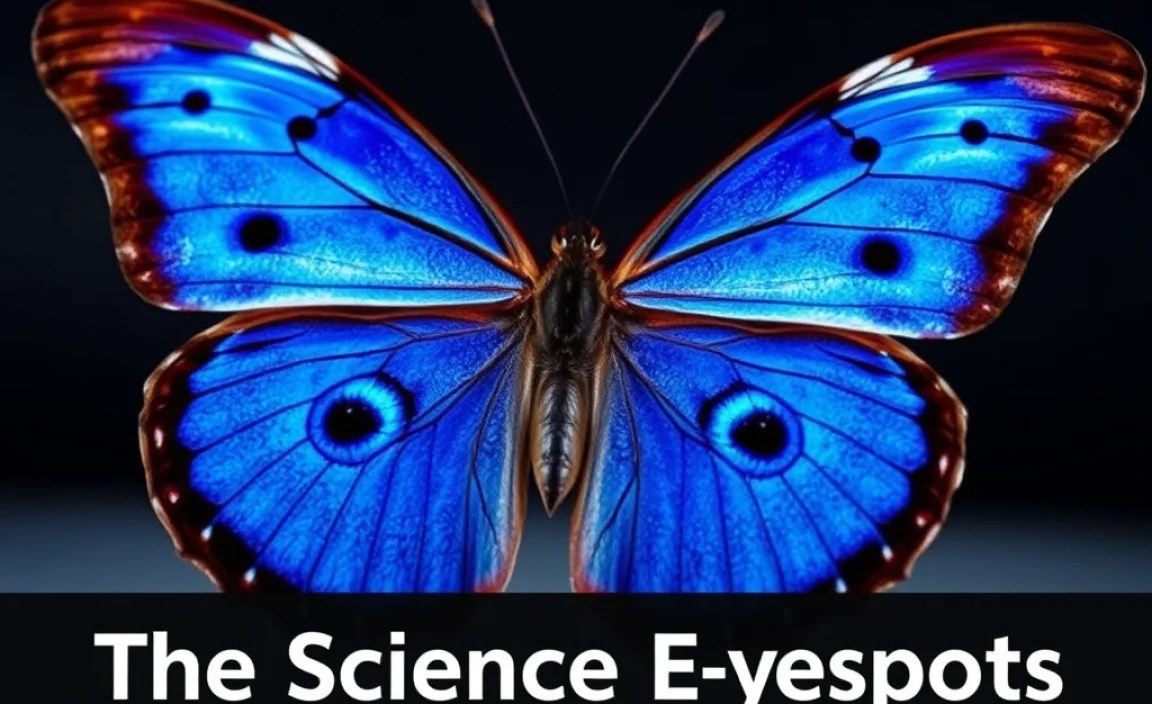
Butterfly wings are like tiny canvases. They display amazing patterns and colors. Scientists study these patterns to understand how they develop. They want to know how genes and the environment play a role. The *Blue Morpho eyespots function* is just one part of this bigger picture. The patterns on butterfly wings are not random. They are carefully controlled by genes. These genes tell the cells on the wings what colors to make. They also tell them where to put the colors. This creates the intricate patterns that we see. Scientists use microscopes and other tools to study these patterns. They can even change the genes to see how it affects the wing patterns. This helps us learn more about how butterflies develop and evolve.
- Genes control wing patterns.
- Cells make different colors.
- Patterns help with camouflage.
- Patterns help attract mates.
- Scientists study wing patterns.
Imagine you are a scientist studying butterfly wings. You would use a microscope to look at the tiny scales on the wings. Each scale has a different color. You would try to figure out how the cells make these colors. You might also try to change the genes to see what happens to the wing patterns. This is what scientists do every day. They are trying to unlock the secrets of butterfly wings. Their research can help us understand how genes work. It can also help us learn more about evolution and adaptation. The study of butterfly wings is a fascinating field.
Fun Fact or Stat: Butterfly wings are covered in tiny scales, like shingles on a roof!
The Role of Pigments
What makes the colors on butterfly wings? The answer is pigments. Pigments are substances that absorb certain colors of light and reflect others. For example, a blue pigment absorbs all colors of light except blue. It reflects the blue light back to our eyes, so we see the color blue. Butterflies use different types of pigments to create their wing colors. Some pigments are made by the butterfly’s body. Others are obtained from the food they eat. The Blue Morpho gets its blue color from special pigments. These pigments are arranged in a way that reflects blue light.
Structural Coloration
The Blue Morpho’s blue color is not just from pigments. It also comes from structural coloration. Structural coloration is when the structure of the wing reflects light in a certain way. The Blue Morpho’s wings have tiny scales that are shaped like prisms. These prisms reflect blue light very strongly. This makes the blue color appear very bright and shiny. Structural coloration is also responsible for the iridescent colors of some butterflies. Iridescent colors change depending on the angle you look at them. The Blue Morpho’s wings are a great example of how both pigments and structure can create beautiful colors.
Evolution of Wing Patterns
How did butterfly wing patterns evolve? Scientists believe that wing patterns evolved through natural selection. Butterflies with patterns that helped them survive and reproduce were more likely to pass on their genes. For example, butterflies with eyespots that scared away predators were more likely to survive. They would then have more babies. Over time, the eyespot pattern became more common in the population. This is how natural selection works. It favors traits that help animals survive and reproduce. The *Blue Morpho eyespots function* shows how evolution can lead to amazing adaptations.
Camouflage and Mimicry in Blue Morphos

The Blue Morpho is not just about bright blue wings. It also uses camouflage and mimicry to stay safe. The underside of its wings is brown. This helps it blend in with the trees and leaves. When the butterfly is resting, it can close its wings. This makes it almost invisible to predators. This is called camouflage. The *Blue Morpho eyespots function* can also be considered a form of mimicry. The eyespots mimic the eyes of a larger animal. This can scare away predators. Camouflage and mimicry are important survival strategies for many animals. They help them avoid being seen or eaten.
- Brown underside for camouflage.
- Eyespots mimic larger animal eyes.
- Camouflage helps them hide from predators.
- Mimicry scares away predators.
- They are both survival strategies.
Imagine you are trying to hide in a forest. You would want to wear clothes that blend in with the trees and leaves. This is what camouflage is all about. The Blue Morpho does this naturally with its brown wings. Now, imagine you are trying to scare someone. You might make a loud noise or pretend to be a monster. This is what mimicry is all about. The Blue Morpho uses its eyespots to mimic a larger animal. These strategies help the butterfly survive in a dangerous world.
Fun Fact or Stat: Some butterflies can taste with their feet!
Blending into the Environment
How does the Blue Morpho blend into its environment? The brown underside of its wings helps it match the color of tree bark and dead leaves. When the butterfly is resting on a tree branch, it can be very difficult to spot. This helps it avoid being seen by predators. The butterfly also has a special way of flying. It flits and flutters erratically. This makes it harder for predators to track. The Blue Morpho uses a combination of camouflage and behavior to stay safe. This is a great example of how animals adapt to their surroundings.
The Power of Deception
The *Blue Morpho eyespots function* is an example of deception. Deception is when an animal tries to trick another animal. In this case, the butterfly is trying to trick predators into thinking it is a larger, more dangerous animal. Deception is a common strategy in the animal kingdom. Many animals use it to avoid being eaten or to catch prey. For example, some spiders mimic ants to avoid being attacked by other spiders. Some fish mimic cleaner fish to get close to their prey. Deception is a powerful tool for survival.
Why Camouflage Matters
Why is camouflage so important for the Blue Morpho? The rainforest is full of predators. Birds, lizards, and other animals are always on the lookout for a tasty meal. If the Blue Morpho was brightly colored all the time, it would be easy to spot. It would quickly become a meal for a predator. Camouflage helps the butterfly stay hidden. This gives it a better chance of surviving and reproducing. Without camouflage, the Blue Morpho would not be able to survive in the rainforest. It’s an essential adaptation.
Predators and Prey: The Blue Morpho’s Role
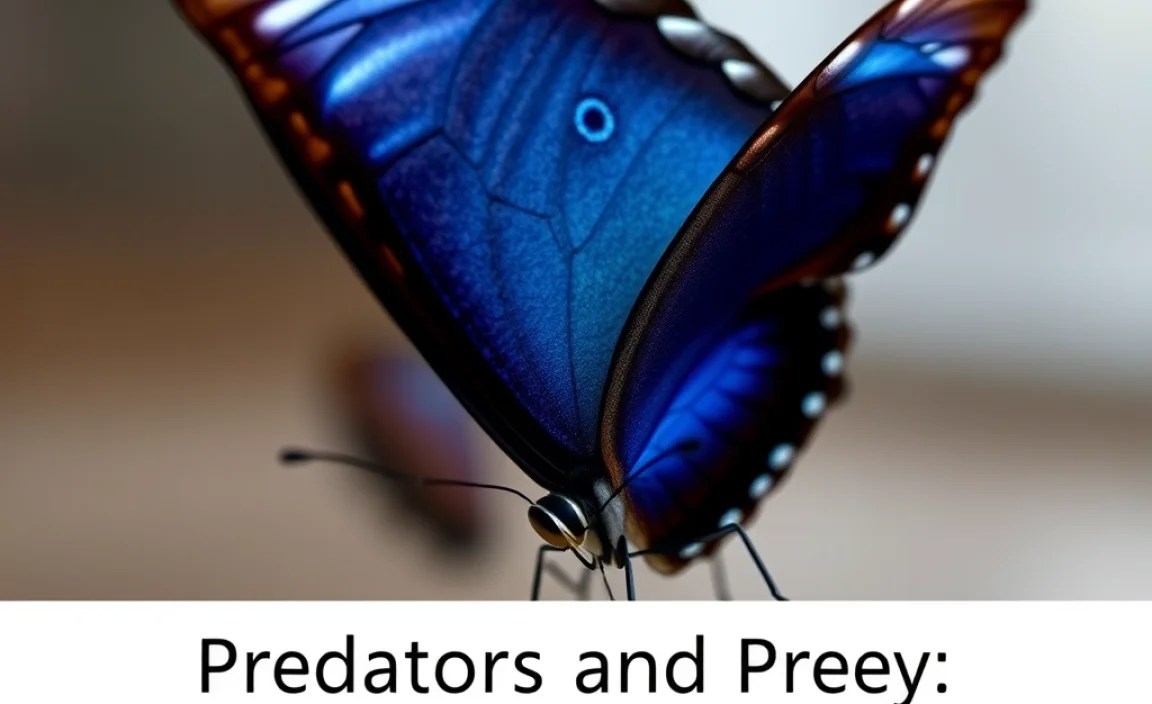
The Blue Morpho is part of a complex food web in the rainforest. It is both a predator and prey. As a caterpillar, it eats leaves. As a butterfly, it drinks nectar from flowers. It is also food for birds, lizards, and other animals. The *Blue Morpho eyespots function* helps it avoid becoming prey. The butterfly’s role in the food web is important for the health of the rainforest ecosystem. It helps to control the population of plants and insects. It also provides food for other animals. If the Blue Morpho disappeared, it would have a ripple effect throughout the ecosystem.
- Eats leaves as a caterpillar.
- Drinks nectar as a butterfly.
- Is food for birds and lizards.
- Eyespots help it avoid predators.
- Important for rainforest ecosystem.
Imagine the rainforest as a giant puzzle. Each plant and animal is a piece of the puzzle. The Blue Morpho is one of those pieces. If you remove the Blue Morpho, the puzzle would be incomplete. The ecosystem would be out of balance. Some plants might become too common. Other animals might not have enough to eat. The Blue Morpho plays a vital role in keeping the rainforest healthy. That is why it is important to protect this amazing butterfly and its habitat.
Fun Fact or Stat: Blue Morpho caterpillars can be cannibalistic, meaning they sometimes eat each other!
What Eats Blue Morphos?
What are the main predators of the Blue Morpho? Birds are the most common predators. They are always looking for a tasty butterfly to eat. Lizards and other reptiles also prey on Blue Morphos. Even some insects will eat Blue Morpho caterpillars. The butterfly has to be constantly on guard to avoid being eaten. That is why the *Blue Morpho eyespots function* is so important. It helps the butterfly stay one step ahead of its predators. Survival is a daily challenge in the rainforest.
What Do Blue Morphos Eat?
What does the Blue Morpho eat? As a caterpillar, it eats the leaves of various plants. As a butterfly, it drinks nectar from flowers. It also drinks the juices from rotting fruit. Blue Morphos have a special proboscis, or tongue, that they use to suck up liquids. They are not picky eaters. They will eat almost anything that provides them with energy. This helps them survive in the rainforest, where food can sometimes be scarce. Their diet changes as they grow.
The Balance of Nature
The relationship between the Blue Morpho and its predators is an example of the balance of nature. Predators keep the butterfly population in check. This prevents the butterflies from overeating the plants in the rainforest. The butterflies, in turn, provide food for the predators. This creates a cycle of life that is essential for the health of the ecosystem. When this balance is disrupted, it can have serious consequences. For example, if the predator population declines, the butterfly population might explode. This could lead to overgrazing and damage to the rainforest.
Habitat and Conservation of Blue Morphos

Blue Morphos live in the rainforests of Central and South America. These rainforests are under threat from deforestation. Deforestation is when trees are cut down to make way for farms, cities, and other developments. This destroys the Blue Morpho’s habitat. It also makes it harder for them to find food and mates. Conservation efforts are underway to protect the Blue Morpho and its habitat. These efforts include creating protected areas, promoting sustainable farming, and educating people about the importance of rainforests. The *Blue Morpho eyespots function* will be useless if they lose their habitat.
- Live in rainforests of Central and South America.
- Rainforests are threatened by deforestation.
- Deforestation destroys their habitat.
- Conservation efforts are underway.
- Protecting rainforests is important.
Imagine the rainforest as a home for the Blue Morpho. Now, imagine that home being torn down, piece by piece. That is what deforestation is doing to the Blue Morpho’s habitat. It is destroying their home and making it harder for them to survive. We need to protect these rainforests. We can do this by supporting sustainable farming practices. We can also reduce our consumption of products that contribute to deforestation. By working together, we can help save the Blue Morpho and its rainforest home.
Fun Fact or Stat: Some Blue Morpho species are becoming endangered due to habitat loss.
Threats to Their Survival
What are the biggest threats to the Blue Morpho’s survival? Deforestation is the biggest threat. As rainforests are destroyed, the Blue Morpho loses its habitat and food sources. Climate change is also a threat. Changes in temperature and rainfall can disrupt the butterfly’s life cycle. Pollution from pesticides and other chemicals can also harm the Blue Morpho. These threats are all interconnected. They all contribute to the decline of the Blue Morpho population.
Conservation Efforts
What are some of the conservation efforts being undertaken to protect Blue Morphos? One important effort is the creation of protected areas. These areas are set aside as reserves where deforestation is prohibited. This gives the Blue Morpho a safe place to live and breed. Another effort is promoting sustainable farming practices. This involves using farming methods that do not harm the rainforest. These efforts can help protect the Blue Morpho and its habitat.
How You Can Help
How can you help protect Blue Morphos? There are many things you can do. You can learn more about the importance of rainforests and share what you learn with others. You can support organizations that are working to protect rainforests. You can also reduce your consumption of products that contribute to deforestation. Even small actions can make a big difference. Together, we can help save the Blue Morpho and its rainforest home. Every little bit counts.
Comparing Blue Morpho Eyespots to Other Species
The *Blue Morpho eyespots function* is a clever defense. But many other animals use eyespots too. Moths, fish, and even some amphibians have them. It is interesting to compare how different species use eyespots. Some species use them to startle predators. Others use them to distract predators. Still others use them to mimic the eyes of larger animals. The specific function of eyespots varies from species to species. But the overall goal is the same: to increase their chances of survival.
- Many animals use eyespots.
- Moths, fish, and amphibians have them.
- They startle or distract predators.
- They mimic larger animal eyes.
- Function varies by species.
Imagine you are a scientist studying eyespots. You would want to compare the eyespots of different species. You would look at their size, shape, and location. You would also study how predators react to the eyespots. This would help you understand how eyespots work and why they are so effective. By comparing different species, you can learn more about the evolution and function of eyespots. It’s a fascinating area of study.
Fun Fact or Stat: Some moths have eyespots that look like owl eyes!
Moth Eyespots
How do moth eyespots compare to Blue Morpho eyespots? Moth eyespots are often larger and more colorful. They are also more likely to be used to startle predators. When a predator approaches, the moth will flash its eyespots. This can startle the predator and give the moth time to escape. Moth eyespots are a great example of how animals use visual signals to defend themselves. They are quite effective at scaring away birds and other predators.
Fish Eyespots
How do fish eyespots compare to Blue Morpho eyespots? Fish eyespots are often located near the tail. They are used to distract predators. When a predator attacks, it will often aim for the eyespot. This gives the fish a chance to escape. Fish eyespots are a clever way to redirect a predator’s attack. They can save the fish’s life. This is a great example of adaptation.
Amphibian Eyespots
How do amphibian eyespots compare to Blue Morpho eyespots? Amphibian eyespots are often found on their backs. They are used to mimic the eyes of larger animals. This can scare away predators. Amphibian eyespots are a form of mimicry. They help the amphibian look more dangerous than it actually is. This is a common defense strategy in the animal kingdom.
Table: Eyespot Comparison
Here is a table comparing the eyespots of different species:
| Species | Eyespot Location | Function | Effectiveness |
|---|---|---|---|
| Blue Morpho Butterfly | Wings | Startle/Mimicry | High |
| Moths | Wings | Startle | Medium |
| Fish | Tail | Distraction | Medium |
| Amphibians | Back | Mimicry | Low |
| Peacock | Feathers | Display | High |
The Evolutionary Advantage of Eyespots
Eyespots provide a significant evolutionary advantage. Animals with eyespots are more likely to survive and reproduce. This is because eyespots help them avoid predators. Over time, this advantage leads to the evolution of more elaborate and effective eyespots. The *Blue Morpho eyespots function* demonstrates this principle. The butterfly’s eyespots are a result of millions of years of evolution. They are a testament to the power of natural selection.
- Eyespots help animals survive.
- They avoid predators.
- More likely to reproduce.
- Evolution leads to better eyespots.
- Natural selection is at work.
Imagine you are an animal trying to survive in a dangerous world. You need every advantage you can get. Eyespots can give you that advantage. They can scare away predators, distract them, or even make you look like a more dangerous animal. Over time, animals with better eyespots are more likely to survive and pass on their genes. This leads to the evolution of even more amazing eyespots. It’s a continuous cycle of adaptation.
Fun Fact or Stat: Some animals can even move their eyespots to make them look more realistic!
Natural Selection and Eyespots
How does natural selection lead to the evolution of eyespots? Natural selection favors traits that help animals survive and reproduce. Animals with eyespots are more likely to survive because they are better at avoiding predators. They are also more likely to reproduce because they live longer. Over time, this leads to the spread of eyespots throughout the population. This is how natural selection works. It favors traits that are beneficial to survival and reproduction.
Genetic Basis of Eyespots
What is the genetic basis of eyespots? Eyespots are controlled by genes. These genes determine the size, shape, and location of the eyespots. They also determine the colors of the eyespots. Scientists have identified some of the genes that are involved in eyespot development. By studying these genes, we can learn more about how eyespots evolve. It’s a complex area of genetics.
The Future of Eyespot Research
What is the future of eyespot research? Scientists are continuing to study eyespots to learn more about their evolution and function. They are also using eyespots as a model for understanding how complex patterns develop in animals. Eyespot research has the potential to teach us a lot about evolution, genetics, and development. It is an exciting field with many unanswered questions. We are just beginning to scratch the surface of understanding these amazing adaptations.
Summary
The *Blue Morpho eyespots function* primarily as a defense mechanism. These distinctive markings on their wings help to deter predators. They achieve this by creating the illusion of larger, more threatening eyes. This startles potential attackers. It gives the butterfly a chance to escape. The underside of the wings is brown. This provides camouflage when the butterfly is resting. Blue Morphos play a vital role in the rainforest ecosystem. They contribute to pollination and serve as a food source for other animals.
However, their habitat is under threat from deforestation. Conservation efforts are important to protect these amazing creatures. Understanding the *Blue Morpho eyespots function* and its ecological role highlights the importance of preserving biodiversity. It emphasizes the need to protect the rainforests where they live.
Conclusion
The Blue Morpho butterfly is a fascinating insect. Its bright blue wings and eyespots make it a unique creature. The *Blue Morpho eyespots function* is a clever adaptation. It helps the butterfly survive in a dangerous environment. By understanding how eyespots work, we can learn more about evolution and the amazing adaptations of animals. Protecting the Blue Morpho and its habitat is vital. It ensures that future generations can appreciate this beautiful butterfly.
Frequently Asked Questions
Question No 1: What is the main purpose of the Blue Morpho’s eyespots?
Answer: The main purpose of the Blue Morpho’s eyespots is to scare away predators. The eyespots look like the eyes of a larger animal. This can startle predators and give the butterfly a chance to escape. This is a form of mimicry. The butterfly is mimicking the appearance of a more dangerous animal. It’s a really cool way for the butterfly to protect itself in the rainforest. Survival in the rainforest can be tough. So the *Blue Morpho eyespots function* is really important.
Question No 2: How do the eyespots help the Blue Morpho survive in the rainforest?
Answer: The rainforest is a dangerous place for butterflies. There are many predators that want to eat them. The eyespots help the Blue Morpho survive by scaring away these predators. When a predator sees the eyespots, it might think that the butterfly is a larger, more dangerous animal. This can deter the predator from attacking. The *Blue Morpho eyespots function* as a defense mechanism. They help to increase the butterfly’s chances of survival in a challenging environment. It is a great adaptation for survival.
Question No 3: Are there other butterflies that have eyespots?
Answer: Yes, there are many other butterflies that have eyespots. Eyespots are a common defense mechanism in the butterfly world. Some butterflies have eyespots that are very similar to the Blue Morpho’s. Others have eyespots that are different in size, shape, or color. The *Blue Morpho eyespots function* is not unique. But it is a good example of how butterflies use eyespots to protect themselves. It is a very common evolutionary strategy.
Question No 4: How do scientists study the function of butterfly eyespots?
Answer: Scientists use a variety of methods to study the function of butterfly eyespots. They can observe how predators react to butterflies with and without eyespots. They can also conduct experiments in the lab. They might create artificial butterflies with different types of eyespots. Then, they can see how predators respond to these artificial butterflies. This helps them understand how eyespots work and why they are so effective. It is a very interesting field of study, to understand how the *Blue Morpho eyespots function*.
Question No 5: What can we do to help protect Blue Morpho butterflies?
Answer: There are many things we can do to help protect Blue Morpho butterflies. One of the most important things is to protect their rainforest habitat. We can do this by supporting organizations that are working to conserve rainforests. We can also reduce our consumption of products that contribute to deforestation. Additionally, we can educate others about the importance of protecting these amazing creatures. Every little bit helps to preserve these butterflies. Understanding the *Blue Morpho eyespots function* may increase appreciation for the butterfly.
Question No 6: Are the eyespots the only defense mechanism Blue Morpho butterflies have?
Answer: No, the eyespots are not the only defense mechanism that Blue Morpho butterflies have. They also have camouflage on the underside of their wings. The underside is brown. This helps them blend in with the trees and leaves. They also have a fast and erratic flight pattern. This makes it harder for predators to catch them. The *Blue Morpho eyespots function* is just one part of a larger defense strategy. The butterflies use many different tricks to stay safe. These tricks are necessary for survival.


