
Asian Butterfly Macro Photography Tips: Ultimate Guide

Have you ever seen a butterfly up close?
They are so pretty and delicate.
Taking pictures of them can be fun.
It can also be tricky!
Do you want to learn Asian butterfly macro photography tips?
This article will show you how.
We will explore the best ways to capture these tiny wonders.
Taking photos of butterflies needs patience.
It also needs the right tools.
We will talk about cameras and lenses.
We will also cover lighting and backgrounds.
With some practice, you can take amazing butterfly photos.
Ready to get started with Asian butterfly macro photography tips?
Key Takeaways
- Use a macro lens to capture the tiny details of Asian butterflies.
- Learn about butterfly behavior for better Asian butterfly macro photography.
- Find the best lighting to show off butterfly colors and patterns.
- Choose backgrounds that make the butterflies stand out in your photos.
- Be patient and quiet to get close to the butterflies without scaring them.
Gear for Asian Butterfly Macro Photography

To start, you need the right gear.
A macro lens is very important.
It lets you take super close-up photos.
Look for a lens that can focus very closely.
A 100mm macro lens is a good choice.
You also need a good camera.
A DSLR or mirrorless camera works well.
These cameras let you change lenses.
They also have better image quality.
A tripod can also be helpful.
It keeps your camera steady.
This is important for sharp macro photos.
A remote shutter release can help too.
It lets you take photos without touching the camera.
This avoids shaking the camera.
Good gear helps you get great Asian butterfly macro photos.
- Macro lens (100mm is a good start)
- DSLR or mirrorless camera
- Tripod for steady shots
- Remote shutter release
- External flash (optional)
- Diffuser for soft light
Think about adding a flash.
But use it carefully!
Direct flash can be too harsh.
Use a diffuser to soften the light.
This makes the colors look more natural.
A ring flash is another good option.
It gives even light around the subject.
Also, remember extra batteries!
Macro photography can take time.
You don’t want your camera to die.
With the right gear, you’re ready to capture beautiful Asian butterflies.
Having the right gear is the first step to amazing macro photos.
Why a Macro Lens Matters
Have you ever tried taking a picture of something really small?
It can be hard to get the details.
A macro lens is made for this.
It lets you focus very closely.
You can see tiny details you would miss otherwise.
The patterns on a butterfly’s wings are amazing.
A macro lens shows every little scale.
You can see the colors and textures clearly.
Normal lenses can’t do this.
They can’t focus close enough.
A macro lens opens up a new world.
It lets you see the beauty of small things.
For Asian butterfly macro photography, it is a must-have.
Choosing the Right Camera Body
Think of your camera as the painter’s canvas.
The camera body is very important.
It controls how the image looks.
A good camera body gives you more control.
It lets you adjust settings like ISO and aperture.
This is important for macro photography.
You need to control the light carefully.
A camera with good low-light performance is helpful.
Butterflies are often in shady areas.
A camera with a high megapixel count is also good.
This lets you crop the image without losing detail.
Choose a camera body that feels good in your hands.
It should be easy to use and have the features you need.
Tripod Benefits for Sharpness
Imagine trying to draw a straight line on a bumpy road.
It is very hard, right?
The same is true for taking photos.
Even a tiny movement can blur the image.
A tripod keeps your camera still.
This is important for sharp macro photos.
Macro photography often uses slow shutter speeds.
This means the camera is taking a picture for a longer time.
Any movement during this time will cause blur.
A tripod eliminates this problem.
It lets you take clear, detailed photos.
Especially when photographing Asian butterflies that move around.
Fun Fact or Stat: The highest resolution macro photo ever taken was of a snowflake, and it revealed details invisible to the naked eye!
Finding Asian Butterfly Subjects
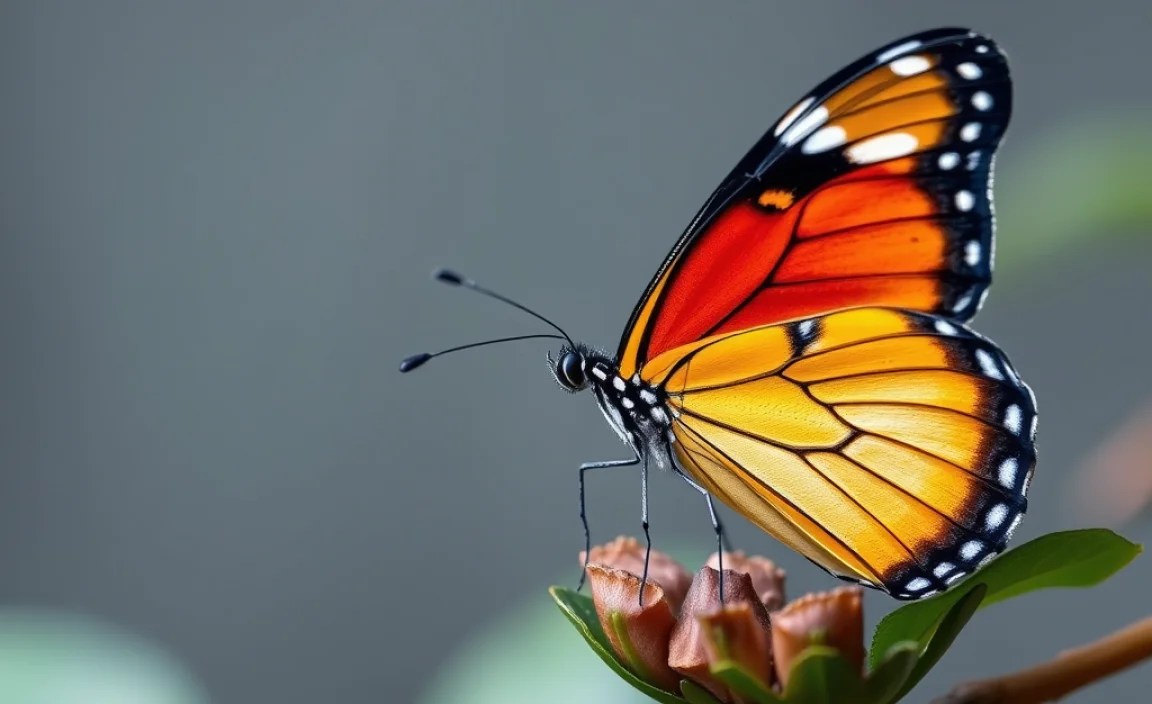
Where do you find butterflies?
That is a very important question.
You need to know their favorite spots.
Gardens are a great place to start.
Look for flowers that butterflies like.
Butterfly bushes are very popular.
Milkweed is another good choice.
Parks and nature reserves are also good.
These places often have many butterflies.
Go out in the morning.
Butterflies are often more active then.
They are warming up in the sun.
Look for butterflies feeding on flowers.
Or resting on leaves.
Be patient and quiet.
Don’t scare them away!
Knowing where to find butterflies is key for Asian butterfly macro photography.
- Visit gardens with butterfly-friendly flowers.
- Explore parks and nature reserves.
- Go out in the morning for best results.
- Look for butterflies on flowers and leaves.
- Be patient and quiet.
- Learn about local butterfly species.
Knowing the butterfly’s life cycle helps too.
Caterpillars eat certain plants.
Adult butterflies like nectar-rich flowers.
Plant these in your garden to attract them.
Also, avoid using pesticides.
These can harm butterflies and other insects.
Join a local butterfly group.
They can share tips and locations.
Respect the environment.
Don’t disturb the butterflies’ habitat.
Take only photos and leave only footprints.
Finding the right location is crucial for successful Asian butterfly macro photography.
With a little research, you can find many beautiful subjects.
Butterfly-Friendly Gardens
Have you ever walked through a garden filled with butterflies?
It is like stepping into a fairy tale!
Butterfly-friendly gardens are designed to attract butterflies.
They have lots of colorful flowers.
These flowers provide nectar for the butterflies.
They also have host plants for the caterpillars.
These plants provide food for the caterpillars.
Some popular butterfly flowers are zinnias and petunias.
Milkweed is a great host plant for monarch butterflies.
Creating a butterfly-friendly garden is easy.
Just plant the right flowers and avoid pesticides.
You will soon have a garden full of beautiful butterflies.
Best Times of Day to Photograph
Imagine waking up early and seeing the sunrise.
The light is soft and golden.
This is the best time to take photos.
The same is true for butterflies.
They are most active in the morning.
They are warming up in the sun.
The light is also softer then.
This makes the colors look more beautiful.
Avoid taking photos in the middle of the day.
The light is too harsh.
It can create strong shadows.
The late afternoon is also a good time.
The light is softer again.
So, wake up early or go out late for the best light.
Understanding Butterfly Behavior
Have you ever watched a butterfly flitting from flower to flower?
They seem to be dancing in the air.
Understanding their behavior helps you take better photos.
Butterflies are most active when it is warm and sunny.
They need the sun to warm their bodies.
They also like to feed on nectar.
They use their long tongues to sip the nectar.
Butterflies also rest on leaves and flowers.
They are often more still when resting.
This is a good time to take a photo.
Be patient and watch the butterflies.
You will learn their habits and patterns.
This will help you capture amazing photos.
Fun Fact or Stat: Some butterfly species migrate thousands of miles each year, like the Monarch butterflies of North America!
Lighting Tips for Butterfly Photos
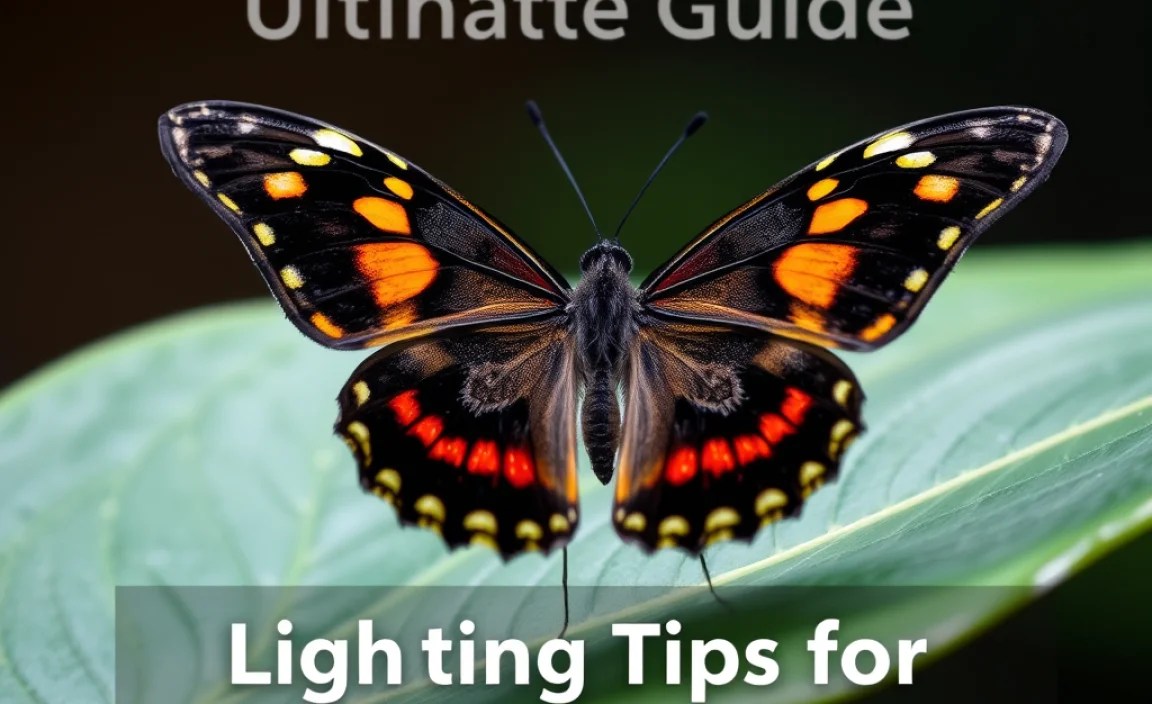
Lighting is very important in photography.
It can make or break your photo.
Soft, natural light is best for butterflies.
Avoid harsh sunlight.
It can create strong shadows.
Overcast days are great for butterfly photos.
The light is even and diffused.
This brings out the colors.
If you must use a flash, use a diffuser.
This softens the light.
It makes it look more natural.
Reflectors can also be helpful.
They bounce light onto the subject.
This fills in shadows.
Pay attention to the direction of the light.
Side lighting can create interesting shadows.
Backlighting can make the wings glow.
Good lighting makes your Asian butterfly macro photos shine.
- Use soft, natural light.
- Avoid harsh sunlight.
- Use a diffuser with a flash.
- Try reflectors to fill in shadows.
- Pay attention to light direction.
- Shoot on overcast days.
Experiment with different lighting angles.
See how they affect the look of the photo.
Morning and evening light is often best.
The sun is lower in the sky.
This creates a warm, golden light.
Use a white balance setting on your camera.
This ensures accurate colors.
Practice adjusting the exposure.
This controls the brightness of the photo.
Lighting is a key element.
Mastering it will improve your Asian butterfly macro photography a lot.
With the right light, you can create stunning images.
Understanding Natural Light
Have you ever noticed how the world looks different at different times of day?
The light changes everything.
Natural light is the light that comes from the sun.
It is the best light for most photos.
Soft, natural light is gentle and flattering.
It brings out the colors and details.
Harsh sunlight can be too strong.
It creates dark shadows and bright highlights.
Overcast days provide soft, even light.
This is perfect for butterfly photos.
Learn to see the light around you.
It will help you take better photos.
Using Flash Effectively
Imagine you’re in a dark room.
You need a light to see.
A flash is like a small, powerful light for your camera.
It can help you take photos in low light.
But flash can also be tricky.
Direct flash can be too harsh.
It can wash out the colors.
Use a diffuser to soften the light.
This makes it look more natural.
You can also bounce the flash off a wall or ceiling.
This spreads the light out.
It creates a softer, more even light.
Use flash carefully and it can improve your photos.
Diffusers and Reflectors
Think of a diffuser as a curtain for your flash.
It softens the light and reduces harsh shadows.
A reflector is like a mirror.
It bounces light onto the subject.
Diffusers and reflectors are very useful tools.
They help you control the light.
They make your photos look more professional.
A diffuser can be as simple as a piece of white cloth.
A reflector can be a piece of cardboard covered in foil.
Experiment with these tools.
See how they change the look of your photos.
They are essential for good Asian butterfly macro photography.
Fun Fact or Stat: The color of light changes throughout the day, with the “golden hour” (shortly after sunrise and before sunset) providing the most flattering light!
Composition Tips for Butterfly Photos
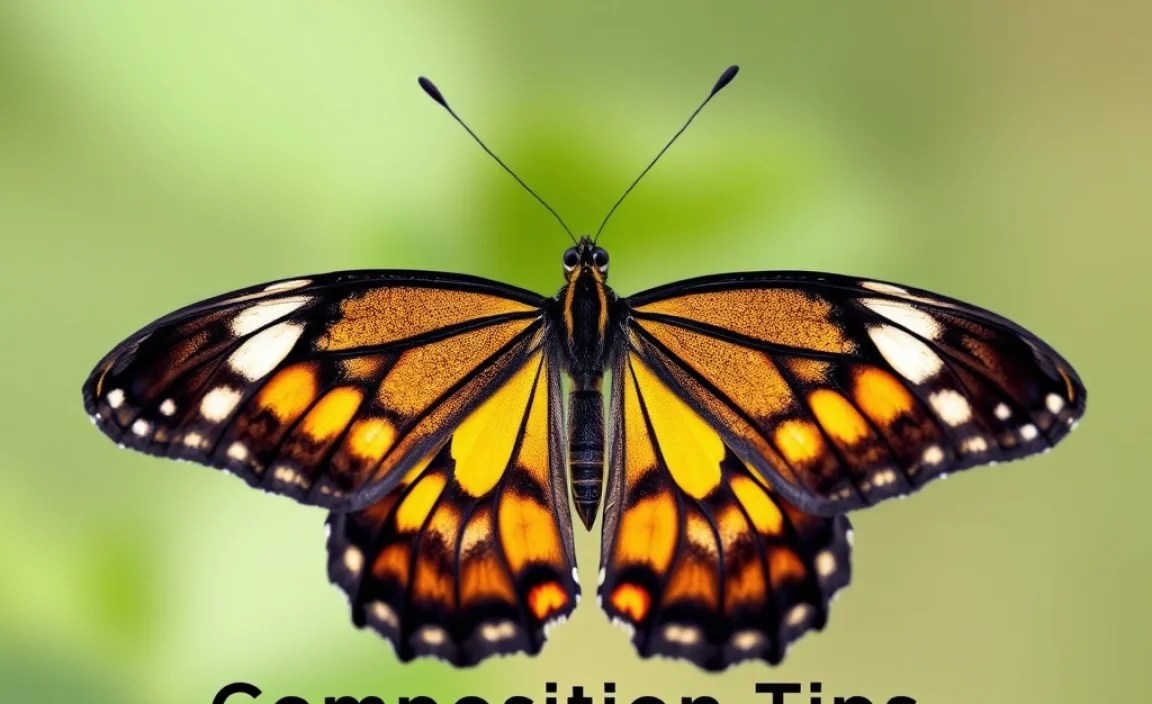
Composition is how you arrange things in your photo.
It’s like arranging a painting.
The rule of thirds is a good starting point.
Imagine dividing your photo into nine equal parts.
Place the butterfly at one of the intersections.
This creates a balanced photo.
Leave some space around the butterfly.
This gives it room to breathe.
Avoid clutter in the background.
A clean background makes the butterfly stand out.
Use leading lines to draw the viewer’s eye.
These are lines that lead to the butterfly.
Consider the angle of your shot.
Shooting from a low angle can be dramatic.
Good composition makes your Asian butterfly macro photos more interesting.
- Use the rule of thirds.
- Leave space around the butterfly.
- Avoid clutter in the background.
- Use leading lines.
- Consider the angle of your shot.
- Focus on the butterfly’s eyes.
Experiment with different compositions.
See what looks best to you.
Try different angles and perspectives.
Get close to the butterfly.
Fill the frame with its wings.
Or step back and show the butterfly in its environment.
Pay attention to the colors in the scene.
Complementary colors can create a striking image.
For example, a blue butterfly on a yellow flower.
Composition is a key part of Asian butterfly macro photography.
It helps you tell a story with your photos.
Rule of Thirds Explained
Imagine drawing two lines across your photo, both horizontally and vertically.
This divides your photo into nine equal parts.
The rule of thirds says to place important elements.
Like the butterfly, along these lines.
Or at the points where the lines intersect.
This creates a more balanced and interesting photo.
It avoids placing the subject in the center.
Which can make the photo look boring.
The rule of thirds is a simple but effective tool.
It can improve your composition a lot.
Backgrounds That Enhance
Think of the background as the stage for your subject.
It should support the subject, not distract from it.
A clean, simple background is best.
It makes the butterfly stand out.
Avoid backgrounds with lots of clutter.
Like busy patterns or bright colors.
A blurry background can also be effective.
This is called bokeh.
It isolates the butterfly and makes it pop.
Use a wide aperture to create bokeh.
Choose a background that complements the butterfly.
For example, a green leaf for a colorful butterfly.
Angles and Perspectives
Have you ever looked at the world from a different angle?
It can change everything.
The same is true for photography.
Shooting from a low angle can make the butterfly look bigger.
It can also create a more dramatic effect.
Shooting from a high angle can show the butterfly in its environment.
It can also create a sense of distance.
Experiment with different angles and perspectives.
See what looks best to you.
Don’t be afraid to get down on the ground.
Or climb up on something for a better view.
Fun Fact or Stat: The “golden ratio,” a mathematical ratio found in nature, is often used in art and photography to create visually pleasing compositions!
Camera Settings for Sharp Butterfly Photos
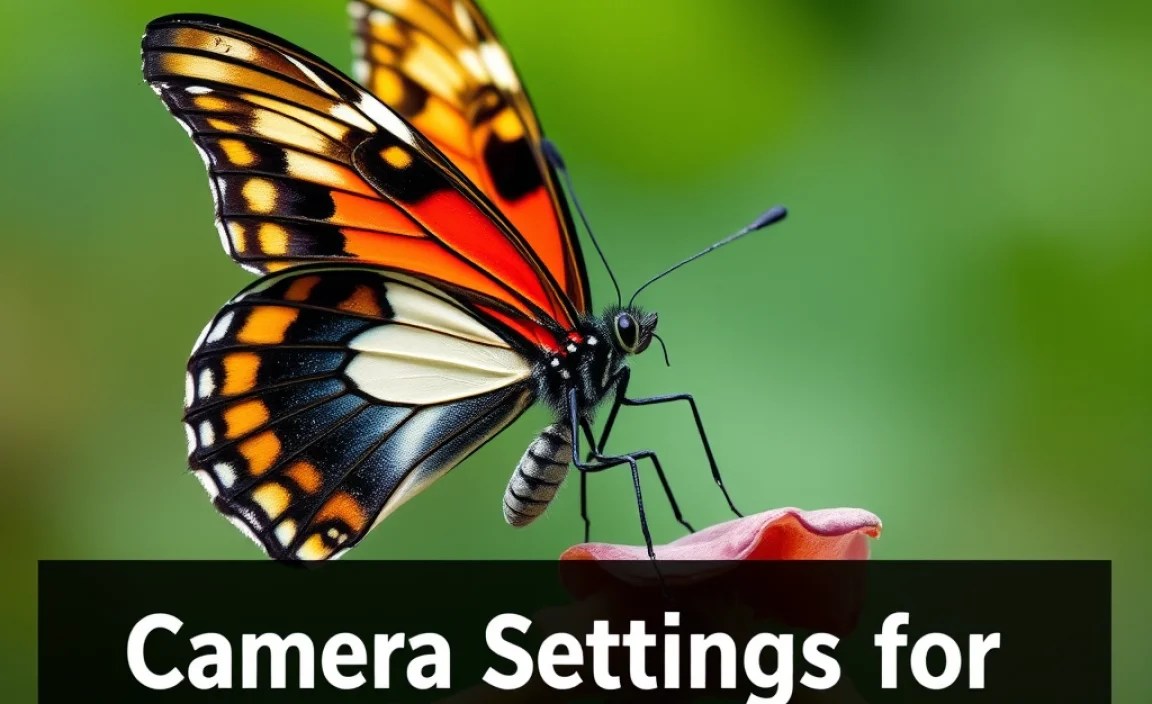
Getting the right camera settings is key.
It ensures your photos are sharp and clear.
Use a small aperture like f/8 or f/11.
This gives you a greater depth of field.
More of the butterfly will be in focus.
Set your ISO as low as possible.
This reduces noise in the image.
Use a fast shutter speed to freeze motion.
1/200th of a second or faster is good.
Use manual focus for precise control.
Focus on the butterfly’s eyes.
They are the most important part of the photo.
Take test shots and adjust your settings.
Practice makes perfect.
Correct settings improve Asian butterfly macro photography.
- Use a small aperture (f/8 to f/11).
- Set ISO as low as possible.
- Use a fast shutter speed (1/200s or faster).
- Use manual focus.
- Focus on the butterfly’s eyes.
- Check your histogram.
Consider using aperture priority mode.
This lets you set the aperture.
The camera chooses the shutter speed.
This is a good way to control depth of field.
Also, use spot metering.
This measures the light in a small area.
It helps you get the right exposure for the butterfly.
Check your histogram.
This shows the brightness of the image.
Adjust your settings until the histogram is balanced.
Mastering these settings will help you take stunning Asian butterfly macro photos.
With the right settings, you can capture every detail.
Aperture and Depth of Field
Imagine looking through a window.
If the window is very clean, everything looks sharp.
If the window is dirty, some things look blurry.
Aperture is like the size of the window opening.
A small aperture makes more of the image sharp.
This is called a large depth of field.
A large aperture makes only a small part of the image sharp.
This is called a shallow depth of field.
For butterfly photos, you want a small aperture.
This ensures the whole butterfly is in focus.
Aperture is a key setting to understand.
ISO and Image Noise
Think of ISO as how sensitive your camera is to light.
A low ISO means the camera is not very sensitive.
This is good for bright conditions.
It produces clean images with little noise.
A high ISO means the camera is very sensitive.
This is good for low-light conditions.
But it can produce noisy images.
Noise looks like tiny dots in the photo.
For butterfly photos, keep the ISO as low as possible.
This ensures the best image quality.
If you need to increase the ISO, do it gradually.
Shutter Speed and Motion Blur
Imagine trying to take a photo of a race car.
If you use a slow shutter speed, the car will look blurry.
If you use a fast shutter speed, the car will look sharp.
Shutter speed controls how long the camera’s sensor is exposed to light.
A fast shutter speed freezes motion.
A slow shutter speed lets motion blur.
For butterfly photos, you want a fast shutter speed.
This prevents motion blur.
Butterflies are always moving.
Even a slight breeze can cause them to move.
Use a shutter speed of 1/200th of a second or faster.
Fun Fact or Stat: The aperture of a lens is measured in f-stops, with smaller numbers (like f/2.8) indicating a wider aperture and more light!
Post-Processing Butterfly Images
Post-processing is editing your photos after you take them.
It can improve the look of your images.
Use software like Adobe Lightroom or Photoshop.
Adjust the exposure to brighten or darken the photo.
Increase the contrast to make the colors pop.
Adjust the white balance to correct the colors.
Sharpen the image to bring out details.
Remove any dust spots or blemishes.
Crop the image to improve the composition.
Post-processing enhances Asian butterfly macro photography.
- Adjust exposure and contrast.
- Correct white balance.
- Sharpen the image.
- Remove dust spots.
- Crop for better composition.
- Reduce noise.
Be careful not to overdo it.
Too much editing can make the photo look unnatural.
Start with small adjustments.
See how they affect the image.
Use layers in Photoshop for more control.
This lets you make adjustments non-destructively.
Save your photos in a high-quality format like JPEG or TIFF.
This preserves the details.
Post-processing is a powerful tool.
Use it to bring out the best in your Asian butterfly macro photos.
With careful editing, you can create stunning images.
Basic Adjustments in Lightroom
Imagine you have a painting that is a little dull.
You can use Lightroom to make it brighter and more colorful.
Lightroom is a software program for editing photos.
It lets you adjust things like exposure, contrast, and white balance.
Exposure controls the brightness of the photo.
Contrast controls the difference between light and dark.
White balance corrects the colors.
These are basic adjustments that can improve any photo.
Lightroom is a great tool for beginners.
Sharpening and Noise Reduction
Think of sharpening as making the details more clear.
It can make your photos look sharper and more defined.
But too much sharpening can create unwanted artifacts.
Noise reduction reduces the amount of noise in the photo.
Noise looks like tiny dots in the image.
It is more common in photos taken at high ISO settings.
Sharpening and noise reduction are important tools.
Use them carefully to improve your photos.
Most photo editing software has these tools.
Cropping and Composition Refinement
Imagine you have a photo that is almost perfect.
But the composition is a little off.
Cropping lets you remove parts of the photo.
This can improve the composition.
You can crop to emphasize the subject.
Or to remove distracting elements.
You can also crop to change the aspect ratio.
The aspect ratio is the shape of the photo.
Cropping is a simple but powerful tool.
It can make a big difference in the final image.
Use it to refine your composition and create a stronger photo.
Fun Fact or Stat: The “healing brush” tool in photo editing software can remove blemishes and distractions, like a tiny Photoshop eraser!
| Tip | Description | Why it Helps |
|---|---|---|
| Use Macro Lens | A macro lens allows for extreme close-up shots. | Captures intricate details of butterflies. |
| Soft Natural Light | Avoid harsh sunlight; use diffusers if needed. | Prevents overexposure and harsh shadows. |
| Small Aperture | Use f/8 to f/11 for a greater depth of field. | Ensures more of the butterfly is in focus. |
| Fast Shutter Speed | Set shutter speed to 1/200s or faster. | Reduces motion blur from butterfly movement. |
| Manual Focus | Use manual focus for precise focusing control. | Allows you to focus exactly where needed (e.g., eyes). |
Summary
Asian butterfly macro photography tips can seem hard at first.
But with practice, anyone can take amazing photos.
Start with the right gear.
A macro lens is essential.
Choose a good camera and a sturdy tripod.
Find butterflies in gardens and parks.
Go out in the morning for the best light.
Use soft, natural light.
Avoid harsh sunlight.
Pay attention to composition.
Use the rule of thirds.
Keep the background clean.
Get your camera settings right.
Use a small aperture and a fast shutter speed.
Edit your photos to enhance them.
Adjust the exposure and sharpen the image.
Remember to be patient and respectful.
Don’t disturb the butterflies’ habitat.
Take only photos and leave only footprints.
With these Asian butterfly macro photography tips, you’ll be taking stunning photos in no time.
So grab your camera and start exploring the world of butterflies!
Conclusion
Taking pictures of Asian butterflies is a fun hobby.
It helps you see the beauty of nature.
You need the right gear and some skill.
Learn about lighting and composition.
Practice using your camera settings.
Be patient and quiet when you are near butterflies.
Edit your photos to make them even better.
Follow these Asian butterfly macro photography tips.
You will capture amazing images.
Have fun exploring the world of tiny wonders!
Frequently Asked Questions
Question No 1: What is a macro lens and why do I need one for butterfly photography?
Answer: A macro lens is a special lens.
It lets you take very close-up photos.
It can focus on things that are very small.
This is important for butterfly photography.
Butterflies are small and have tiny details.
A macro lens lets you capture these details clearly.
You can see the patterns on their wings.
You can see their eyes and antennae.
Without a macro lens, it is hard to get these close-up shots.
It is a must-have for Asian butterfly macro photography.
Question No 2: What are the best camera settings for photographing butterflies in Asia?
Answer: The best camera settings depend on the light.
Start with a small aperture.
This gives you a greater depth of field.
Try f/8 or f/11.
Set your ISO as low as possible.
This reduces noise.
Use a fast shutter speed.
This freezes motion.
1/200th of a second or faster is good.
Use manual focus for precise control.
Focus on the butterfly’s eyes.
Adjust your settings as needed.
Practice makes perfect when finding the best settings for Asian butterfly macro photography.
Question No 3: How can I find butterflies to photograph in Asia?
Answer: There are many places to find butterflies.
Gardens are a great place to start.
Look for flowers that butterflies like.
Butterfly bushes and milkweed are popular.
Parks and nature reserves are also good.
Go out in the morning.
Butterflies are often more active then.
They are warming up in the sun.
Look for butterflies feeding on flowers.
Or resting on leaves.
Be patient and quiet.
Don’t scare them away!
Knowing where to look helps with Asian butterfly macro photography.
Question No 4: What are some tips for getting close to butterflies without scaring them?
Answer: Getting close to butterflies needs patience.
Move slowly and quietly.
Avoid sudden movements.
Wear clothes that blend in with the environment.
Avoid bright colors.
Approach the butterfly from the side.
This is less threatening.
Use a long lens if you have one.
This lets you stay further away.
Be respectful of their space.
Don’t touch or disturb them.
With practice, you can get close to take great Asian butterfly macro photos.
Question No 5: How important is lighting when taking macro photos of butterflies?
Answer: Lighting is very important.
It can make or break your photo.
Soft, natural light is best.
Avoid harsh sunlight.
It can create strong shadows.
Overcast days are great for butterfly photos.
The light is even and diffused.
This brings out the colors.
If you must use a flash, use a diffuser.
This softens the light.
Pay attention to the direction of the light.
Good lighting is key for successful Asian butterfly macro photography.
Question No 6: What post-processing techniques can enhance my butterfly photos?
Answer: Post-processing can greatly improve your photos.
Adjust the exposure to brighten or darken the photo.
Increase the contrast to make the colors pop.
Adjust the white balance to correct the colors.
Sharpen the image to bring out details.
Remove any dust spots or blemishes.
Crop the image to improve the composition.
Be careful not to overdo it.
Too much editing can make the photo look unnatural.
Used carefully, post-processing improves Asian butterfly macro photography.


