
Glasswing Butterfly Anti Glare Coating: Secret Tech?

Quick Summary: The glasswing butterfly’s wings have a natural anti-glare coating due to their unique nanostructures. These structures scatter light, reducing reflections and making the wings transparent. Scientists study these structures to create new anti-reflective coatings for various technologies like screens and solar panels. By understanding this natural phenomenon, we can develop more efficient and eco-friendly materials.
Have you ever wondered how the glasswing butterfly’s wings are so incredibly clear? It’s not magic, but a fascinating feat of natural engineering! Their wings seem invisible, allowing them to blend seamlessly into their surroundings. This transparency is due to a special anti-glare coating on their wings, a feature that scientists are now studying to improve our own technologies.
Understanding how this works can unlock new possibilities for making screens easier to view, solar panels more efficient, and windows less reflective. Let’s explore the science behind this natural marvel and see how it inspires innovation!
Understanding the Glasswing Butterfly’s Anti-Glare Coating

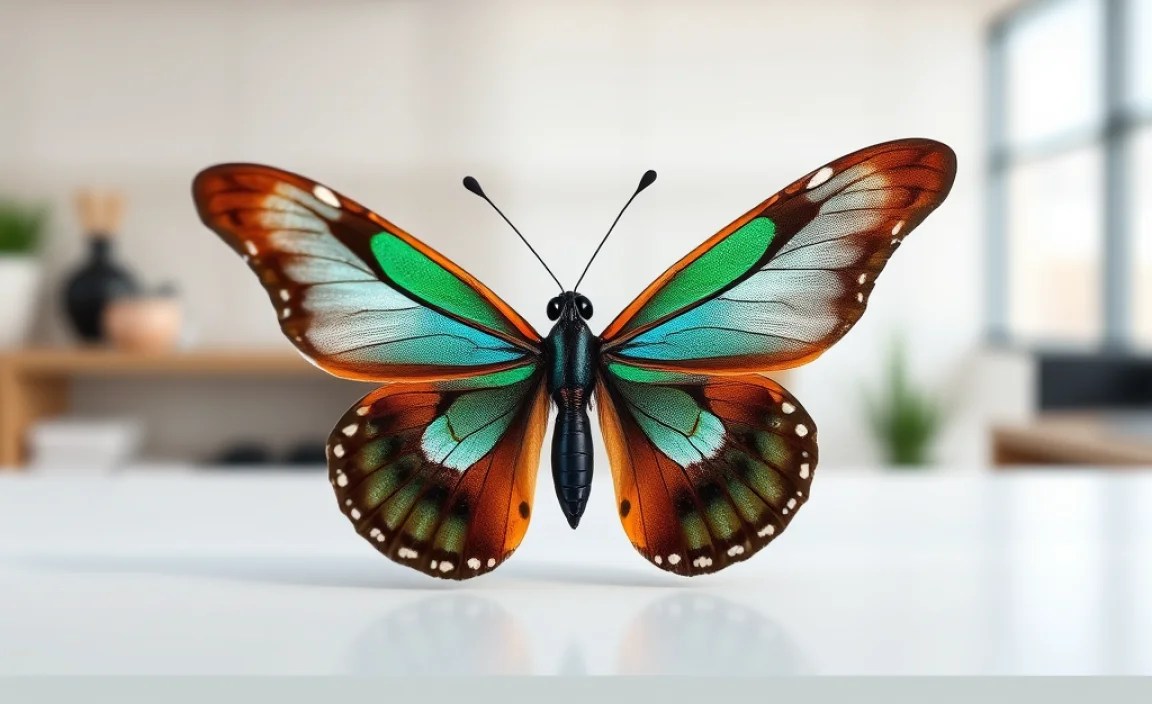
The glasswing butterfly (Greta oto) is famous for its transparent wings. Unlike most butterflies, whose wings are covered in colorful scales, the glasswing has evolved a unique adaptation to minimize reflection and maximize transparency. This adaptation involves special nanostructures on the wing surface that act as an anti-glare coating.
What Makes the Wings Transparent?
The transparency of the glasswing butterfly’s wings comes from a combination of factors:
- Nanostructures: The wing surface is covered in tiny pillars, each about 100 nanometers tall and spaced about 100 nanometers apart. These structures are much smaller than the wavelength of visible light.
- Scattering of Light: When light hits the wing, these nanostructures scatter it in different directions. This reduces the amount of light reflected directly back to the viewer.
- Reduced Reflection: By scattering light, the wings minimize glare and appear transparent. This helps the butterfly camouflage itself in its natural habitat.
The Science Behind Anti-Glare
The anti-glare effect on the glasswing butterfly’s wings is a result of how light interacts with the nanostructures. These structures create a gradient of refractive index between the air and the wing material. This gradient minimizes the abrupt change in refractive index that would normally cause reflection.
When light encounters a surface, some of it is reflected, and some is transmitted. The amount of reflection depends on the difference in refractive index between the two materials. The greater the difference, the more light is reflected. By creating a gradual transition with nanostructures, the glasswing butterfly reduces the amount of reflected light, making its wings appear transparent.
How Scientists Study the Anti-Glare Coating
Scientists are fascinated by the glasswing butterfly’s anti-glare coating because it offers a natural solution to a common problem. They use various techniques to study the structure and properties of the wings.
Microscopy Techniques
Microscopy is essential for examining the nanostructures on the glasswing butterfly’s wings.
- Scanning Electron Microscopy (SEM): SEM provides high-resolution images of the wing surface. It allows scientists to see the size, shape, and arrangement of the nanostructures.
- Atomic Force Microscopy (AFM): AFM is used to measure the mechanical properties of the wing surface. It can also create detailed maps of the surface topography.
- Optical Microscopy: While less detailed than SEM or AFM, optical microscopy can provide a broader view of the wing structure and how it interacts with light.
Optical Measurements
Optical measurements are used to quantify the anti-glare properties of the wings.
- Spectrophotometry: Spectrophotometry measures the amount of light reflected, transmitted, and absorbed by the wings. This can reveal how effectively the nanostructures reduce reflection.
- Angle-Resolved Scattering: This technique measures the amount of light scattered in different directions. It provides detailed information about how the nanostructures scatter light.
Modeling and Simulation
Computer models and simulations help scientists understand the underlying principles of the anti-glare coating.
- Finite Element Analysis (FEA): FEA is used to simulate how light interacts with the nanostructures. It can predict the amount of reflection and transmission for different wing designs.
- Electromagnetic Simulations: These simulations calculate the electromagnetic fields around the nanostructures. They provide insights into how the structures scatter light at different wavelengths.
Applications Inspired by the Glasswing Butterfly

The glasswing butterfly’s anti-glare coating has inspired numerous applications in various fields. Scientists and engineers are working to replicate this natural phenomenon to improve existing technologies and develop new ones.
Anti-Reflective Coatings for Screens
One of the most promising applications is in the development of anti-reflective coatings for screens. Smartphones, tablets, and computer monitors often suffer from glare, which can make them difficult to use in bright environments. By mimicking the nanostructures on the glasswing butterfly’s wings, researchers can create coatings that reduce glare and improve visibility.
Here’s a comparison of traditional vs. bio-inspired anti-reflective coatings:
| Feature | Traditional Coatings | Bio-Inspired Coatings |
|---|---|---|
| Material | Typically multi-layered thin films of inorganic materials | Potentially single-layered or using bio-compatible materials |
| Structure | Uniform layers | Nanostructured surfaces |
| Performance | Effective but can be complex and costly to produce | Potentially more effective at wider angles and bandwidths |
| Durability | Can be prone to scratching and degradation | Potentially more durable due to the nature of nanostructures |
| Manufacturing | Requires precise deposition techniques | Potentially simpler and more scalable manufacturing processes |
Improved Solar Panels
Solar panels are designed to absorb sunlight and convert it into electricity. However, some light is reflected off the surface of the panel, reducing its efficiency. Anti-reflective coatings can minimize this reflection and increase the amount of light absorbed.
By applying coatings inspired by the glasswing butterfly, solar panels can capture more sunlight and generate more electricity. This can lead to more efficient and cost-effective solar energy systems.
Low-Reflectance Windows
Windows with low reflectance can improve the energy efficiency of buildings. Traditional windows reflect a significant amount of sunlight, which can increase the need for air conditioning in the summer. By reducing reflection, low-reflectance windows can keep buildings cooler and reduce energy consumption.
Coatings inspired by the glasswing butterfly can be applied to windows to minimize reflection and improve their energy efficiency. This can lead to significant savings on energy bills and reduce the environmental impact of buildings.
Camouflage Technology
The glasswing butterfly’s transparency is a form of camouflage that allows it to blend into its surroundings. This principle can be applied to develop new camouflage technologies for military and civilian applications.
By creating materials with similar anti-glare properties, it is possible to make objects less visible to the naked eye and to sensors. This could be used to create more effective camouflage for soldiers, vehicles, and equipment.
How to Mimic the Anti-Glare Effect at Home (DIY Projects)

While replicating the exact nanostructures of the glasswing butterfly requires advanced technology, there are some DIY projects you can try at home to mimic the anti-glare effect on a small scale.
Creating a Simple Anti-Glare Screen Protector
This project involves creating a textured surface on a screen protector to scatter light and reduce glare.
- Gather Materials: You will need a clear screen protector, fine sandpaper (600-grit or higher), water, and a soft cloth.
- Prepare the Screen Protector: Lightly wet the sandpaper with water.
- Sand the Surface: Gently sand the surface of the screen protector in a circular motion. Apply even pressure to create a uniform texture.
- Rinse and Dry: Rinse the screen protector with water to remove any sanding residue. Dry it thoroughly with a soft cloth.
- Apply to Device: Carefully apply the screen protector to your device, ensuring there are no air bubbles.
The fine texture created by the sandpaper will scatter light and reduce glare on your screen.
Making a Diffuser for a Flashlight
This project involves creating a diffuser for a flashlight to soften the light and reduce harsh shadows.
- Gather Materials: You will need a flashlight, tracing paper or vellum, scissors, and tape.
- Cut the Paper: Cut a piece of tracing paper or vellum that is slightly larger than the flashlight lens.
- Create a Dome: Form the paper into a small dome shape.
- Attach to Flashlight: Tape the dome to the front of the flashlight, ensuring it covers the lens.
The tracing paper or vellum will scatter the light from the flashlight, creating a softer and more diffused beam.
Experimenting with Textured Surfaces
You can also experiment with different textured surfaces to see how they affect light reflection.
- Textured Glass: Use textured glass for windows or picture frames to reduce glare.
- Matte Finishes: Apply matte finishes to surfaces to minimize reflection.
- Fabric Diffusers: Use fabric diffusers for lamps and light fixtures to soften the light.
The Ecological Significance of Transparency

The glasswing butterfly’s transparent wings are not just a fascinating scientific phenomenon; they also play a crucial role in its survival. Transparency provides several ecological advantages:
Camouflage
The primary advantage of transparent wings is camouflage. By blending seamlessly into its surroundings, the glasswing butterfly can evade predators and increase its chances of survival. This is particularly important in dense rainforest environments, where visual camouflage is highly effective.
Predator Avoidance
Transparency makes it difficult for predators to detect the butterfly. Birds, lizards, and other insectivores rely on visual cues to find their prey. The glasswing butterfly’s transparent wings disrupt these cues, making it harder for predators to spot.
Mate Attraction
While transparency is important for camouflage, glasswing butterflies also use other strategies to attract mates. Males have scent glands that produce pheromones, which they use to attract females. The combination of transparency for camouflage and pheromones for mate attraction allows the glasswing butterfly to thrive in its environment.
The Future of Bio-Inspired Anti-Glare Technology
The glasswing butterfly’s anti-glare coating is just one example of how nature can inspire technological innovation. As scientists continue to study and understand the principles behind this natural phenomenon, we can expect to see even more applications in the future.
Advanced Materials
Researchers are developing new materials with enhanced anti-glare properties. These materials are designed to mimic the nanostructures on the glasswing butterfly’s wings more closely. They offer the potential for even more effective anti-reflective coatings for screens, solar panels, and windows.
Scalable Manufacturing
One of the challenges in replicating the glasswing butterfly’s anti-glare coating is developing scalable manufacturing processes. Traditional methods for creating nanostructures can be expensive and time-consuming. Researchers are exploring new techniques, such as self-assembly and nanoimprinting, to create these structures more efficiently.
Sustainable Solutions
Bio-inspired anti-glare technology offers the potential for more sustainable solutions. Traditional anti-reflective coatings often involve toxic chemicals and energy-intensive processes. By using natural principles, it is possible to create coatings that are more environmentally friendly.
FAQ About Glasswing Butterfly Anti-Glare Coating
Here are some frequently asked questions about the glasswing butterfly’s anti-glare coating:
What exactly is the anti-glare coating on glasswing butterfly wings?
It’s a natural feature created by tiny nanostructures on the wing surface. These structures scatter light, reducing reflection and making the wings appear transparent.
How do scientists study this coating?
They use advanced microscopy techniques like Scanning Electron Microscopy (SEM) and Atomic Force Microscopy (AFM) to examine the structure. They also use optical measurements to quantify the anti-glare properties.
What are some potential applications of this technology?
Potential applications include anti-reflective coatings for screens, improved solar panel efficiency, low-reflectance windows, and camouflage technology.
Can I replicate this anti-glare effect at home?
While you can’t replicate the exact nanostructures, you can try DIY projects like creating a textured screen protector or a diffuser for a flashlight to mimic the effect on a small scale.
Why is transparency important for the glasswing butterfly?
Transparency helps the butterfly camouflage itself in its natural habitat, making it harder for predators to spot. This increases its chances of survival.
Are there any sustainable benefits to bio-inspired anti-glare technology?
Yes, bio-inspired coatings can be more environmentally friendly than traditional coatings, as they often use less toxic chemicals and energy-intensive processes.
Where can I learn more about glasswing butterflies and their unique adaptations?
You can explore resources from reputable sources like the Smithsonian Institution, National Geographic, and university research papers on insect biology and biomimicry.
Conclusion
The glasswing butterfly’s anti-glare coating is a testament to the wonders of natural engineering. By understanding and mimicking this phenomenon, we can develop innovative technologies that improve our lives and protect our environment. From enhancing the clarity of our screens to boosting the efficiency of solar panels, the possibilities are endless. Next time you see a butterfly, remember that it might just hold the key to the future of technology!


