Easy Species Identification of Barnacles: A Quick Guide

Did you ever see a boat covered in little shells? Those are often barnacles. Barnacles stick to rocks, boats, and even whales! There are many types of barnacles in the sea. Figuring out what kind they are is called species identification of barnacles. It helps us learn about the ocean.
Barnacles are not just shells. They are living animals. They can be a problem for boats. But they are also an important part of the ocean food chain. So, how can scientists tell them apart? Let’s explore how we do species identification of barnacles.
It’s like being a detective for the sea. You look for clues to solve a mystery. The clues are the barnacle’s shape, size, and where it lives. This helps us understand our oceans better. Are you ready to become a barnacle detective?
Key Takeaways
- Species identification of barnacles is important for understanding marine ecosystems and biodiversity.
- Barnacle identification uses shell shape, size, color, and habitat as key indicators.
- Microscopic examination of barnacle body parts helps confirm species.
- Scientists use guides and tools to identify different barnacle types accurately.
- Correct barnacle ID helps track their spread and manage marine environments better.
Understanding Barnacle Species Identification
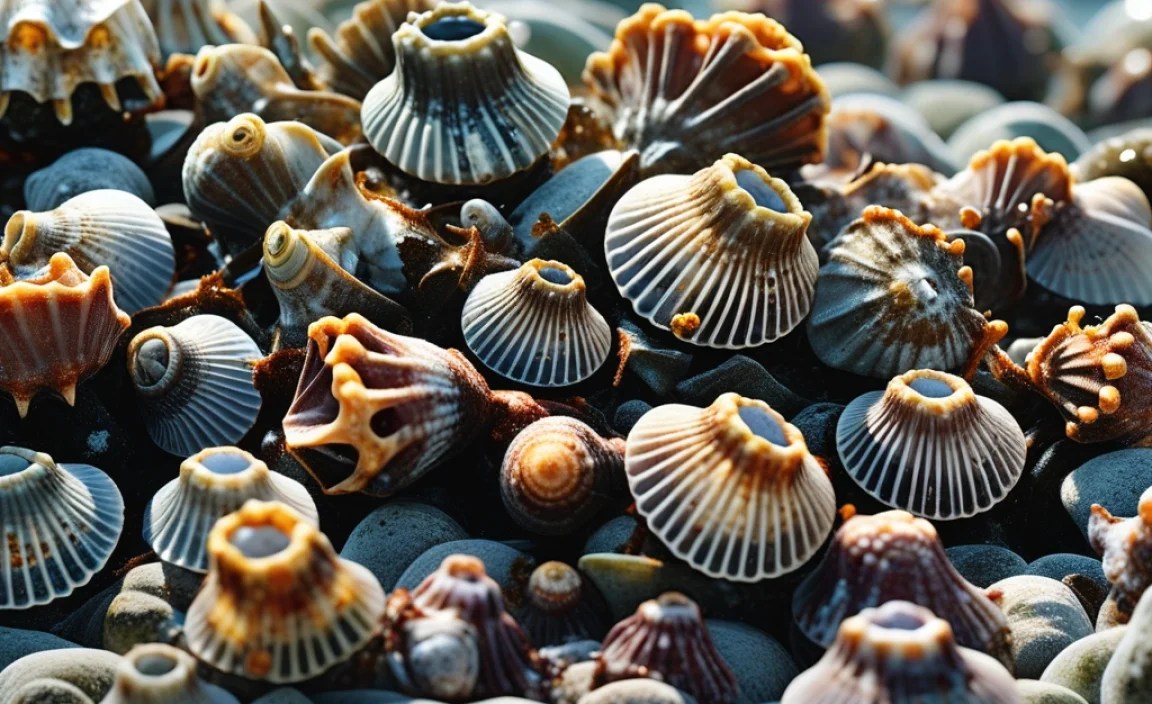
Species identification of barnacles involves carefully observing their physical features. Scientists look at the shape and size of the barnacle’s shell. The shell plates and how they fit together are very important. They also check the operculum. This is the lid that the barnacle uses to open and close its shell. The color of the shell can also be a clue. Some barnacles are white, while others are brown or gray. The location where the barnacle is found matters, too. Some barnacles live only in certain areas of the world. Others prefer specific types of surfaces, like rocks or boats. All these details help scientists figure out which species they’re looking at. Proper species identification of barnacles is like solving a puzzle with many pieces.
- Barnacle shells have different shapes and sizes.
- Shell color can vary among species.
- Operculum shape is a key feature.
- Location is important for identification.
- Scientists use guides to help them.
Barnacles are fascinating creatures that attach themselves to various surfaces in the marine environment. Their ability to thrive in diverse conditions makes species identification of barnacles crucial. Scientists use a combination of morphological and molecular techniques. These methods provide a comprehensive understanding of barnacle diversity. The barnacle’s habitat, whether it’s intertidal rocks or the hull of a ship, offers valuable clues. By studying these creatures, we gain insights into marine ecology and the impact of human activities on coastal ecosystems. This knowledge is essential for conservation efforts and managing marine resources.
Fun Fact or Stat: Barnacles can live for over five years, and some species can even survive for decades!
Why is Barnacle ID Important?
Have you ever wondered why scientists care so much about barnacles? It’s because barnacles can tell us a lot about the ocean. Species identification of barnacles helps us understand how healthy the ocean is. Some barnacles prefer clean water, while others can live in polluted areas. By knowing which barnacles are present, we can learn about water quality. Barnacles can also be indicators of climate change. As the ocean warms, some species may move to new areas. Species identification of barnacles allows us to track these changes. This information helps us protect our oceans and the creatures that live there. It also informs us about our planet’s health.
What Tools Help Identify Species?
Imagine trying to identify a tiny barnacle with just your eyes. It would be very difficult! That’s why scientists use special tools. They use magnifying glasses to see small details on the shell. Microscopes are used to examine even smaller parts of the barnacle. Scientists also use identification guides. These guides have pictures and descriptions of different barnacle species. Some guides even have keys. A key is a series of questions that lead you to the correct species. Scientists also use DNA analysis. This involves looking at the barnacle’s genes. DNA can provide a very accurate species identification of barnacles. All these tools help scientists become expert barnacle detectives.
Where Do Barnacles Live?
Barnacles can live in many different places. Some live on rocks in the intertidal zone. This is the area that is covered by water at high tide and exposed at low tide. Other barnacles live on boats and ships. They can even attach to whales and turtles! Different barnacle species prefer different habitats. Some like warm water, while others like cold water. Some prefer calm waters, while others like areas with strong waves. By knowing where a barnacle lives, scientists can narrow down the possibilities for species identification of barnacles. The location is an important clue in solving the barnacle mystery.
Key Features for Barnacle Identification

To identify barnacles, you need to know what to look for. The shape of the shell is very important. Some barnacles have cone-shaped shells, while others are more flattened. The number of shell plates is another key feature. Most barnacles have six shell plates, but some have four or eight. The arrangement of these plates can also be helpful. The operculum, or lid, can have different shapes and sizes. The color of the shell can also vary. Some barnacles are white, while others are pink, purple, or brown. The size of the barnacle is another clue. Some barnacles are very small, while others can grow quite large. All these features help with accurate species identification of barnacles.
- Shell shape (cone, flat, etc.) is key.
- Count the number of shell plates.
- Check the operculum’s shape.
- Note the barnacle’s color.
- Measure the barnacle’s size.
- Observe the plate arrangement.
Barnacle morphology plays a vital role in distinguishing different species. The intricate details of their shell structure, including the shape and arrangement of plates, provide valuable insights. Examining the internal anatomy, such as the cirri (feeding appendages), can also aid in species identification of barnacles. These characteristics, combined with habitat information, enable researchers to accurately classify barnacles and understand their ecological roles. Proper identification is critical for monitoring biodiversity and assessing the impact of environmental changes on barnacle populations.
Fun Fact or Stat: Some barnacles are hermaphrodites, meaning they have both male and female reproductive organs!
How Does Shell Shape Help?
Have you ever noticed how different barnacles look? Some are tall and pointy, while others are flat and wide. The shell shape is a very important clue for species identification of barnacles. Tall, cone-shaped barnacles often live in areas with strong waves. Their shape helps them withstand the force of the water. Flat barnacles are more common in sheltered areas. The shape of the shell is determined by how the barnacle grows. It is also influenced by the environment. By carefully observing the shell shape, you can learn a lot about a barnacle’s life.
What About Shell Plates?
Imagine the barnacle’s shell as a puzzle. The pieces of the puzzle are called shell plates. Most barnacles have six shell plates. These plates fit together to form a protective cone. Some barnacles have fewer plates, like four. Others have more, like eight. The number and arrangement of shell plates are key features for species identification of barnacles. Scientists carefully count and examine the plates. They also look at how the plates are joined together. These details help them determine the species of the barnacle.
Why is the Operculum Important?
The operculum is like a door for the barnacle’s shell. It’s a lid that the barnacle can open and close. When the tide is in, the barnacle opens its operculum to feed. It uses feathery appendages to catch food from the water. When the tide is out, the barnacle closes its operculum to protect itself from drying out. The shape and size of the operculum can vary among different species. This makes it an important feature for species identification of barnacles. Scientists look closely at the operculum to help them identify the barnacle.
Using Microscopes for Species Identification

Sometimes, the features that help us identify barnacles are very small. That’s when microscopes come in handy. Microscopes allow us to see tiny details that we can’t see with our eyes alone. Scientists use microscopes to examine the barnacle’s body parts. They look at the cirri, which are the feathery appendages the barnacle uses to feed. They also look at the mouthparts and other internal structures. These details can be very helpful for species identification of barnacles. Microscopes open up a whole new world of barnacle features. They help scientists identify even the most difficult species.
- Microscopes reveal tiny details.
- Cirri are examined closely.
- Mouthparts can aid identification.
- Internal structures are observed.
- Details help ID difficult species.
Microscopic examination is an essential tool in the field of marine biology. It enables researchers to delve into the intricate details of barnacle anatomy. By using high-powered microscopes, scientists can observe the minute structures of barnacles, such as their setae and opercular plates. These tiny features often hold the key to accurate species identification of barnacles. The ability to visualize these details allows for a more precise understanding of barnacle diversity and evolutionary relationships.
Fun Fact or Stat: Some barnacles have eyes, but they can only see light and dark, not detailed images!
What are Cirri?
Imagine a barnacle trying to catch food in the ocean. It can’t swim around like a fish. Instead, it uses feathery appendages called cirri. The barnacle sticks its cirri out of its shell and sweeps them through the water. The cirri act like a net, catching tiny plankton and other food particles. The barnacle then pulls the cirri back into its shell and eats the food. The shape and size of the cirri can vary among different species. This makes them a useful feature for species identification of barnacles. Scientists carefully examine the cirri under a microscope to help them identify the barnacle.
Why Look at Mouthparts?
Just like humans, barnacles need to eat to survive. They use mouthparts to break down and consume their food. The shape and structure of the mouthparts can vary among different species. Some barnacles have sharp, pointed mouthparts for tearing apart their prey. Others have more rounded mouthparts for grinding up food. By examining the mouthparts under a microscope, scientists can gather valuable clues for species identification of barnacles. The mouthparts can reveal important information about the barnacle’s diet and lifestyle.
Examining Internal Structures
Sometimes, the best way to identify a barnacle is to look inside. Scientists can dissect barnacles and examine their internal structures. They look at the shape and size of the gut, the reproductive organs, and other internal parts. These features can be very helpful for species identification of barnacles. Of course, this method requires sacrificing the barnacle. But it can provide valuable information that cannot be obtained in any other way. Examining internal structures is a powerful tool for understanding barnacle diversity.
The Role of DNA in Barnacle Species ID
In recent years, scientists have started using DNA to identify barnacles. DNA is the genetic material that carries all the information about an organism. By analyzing a barnacle’s DNA, scientists can determine its species with great accuracy. This is especially helpful for identifying barnacles that look very similar. DNA analysis can also reveal relationships between different barnacle species. It can show how they are related to each other and how they have evolved over time. DNA analysis is becoming an increasingly important tool for species identification of barnacles. It is helping us to understand barnacle diversity better than ever before.
- DNA gives accurate species IDs.
- It helps ID similar-looking barnacles.
- DNA reveals species relationships.
- It shows how barnacles evolved.
- DNA analysis is very powerful.
DNA analysis has revolutionized the field of species identification of barnacles. By examining the genetic material of barnacles, researchers can uncover subtle differences that are not apparent through traditional morphological methods. This approach is particularly useful for resolving taxonomic uncertainties and identifying cryptic species. DNA barcoding, for example, provides a standardized method for identifying species based on short, conserved DNA sequences. This technology has greatly enhanced our ability to assess barnacle diversity and monitor changes in marine ecosystems.
Fun Fact or Stat: Barnacles are more closely related to crabs and lobsters than they are to clams or mussels!
What is DNA Barcoding?
Imagine having a barcode for every living thing. You could scan the barcode and instantly know what it is. That’s the idea behind DNA barcoding. DNA barcoding uses a short, standardized sequence of DNA to identify different species. Scientists can take a small sample of a barnacle’s DNA and compare it to a database of known DNA barcodes. If the barcode matches a known species, then the barnacle is identified. DNA barcoding is a fast and accurate way to identify barnacles. It is becoming an increasingly popular tool for species identification of barnacles.
How Does DNA Reveal Relationships?
DNA can tell us more than just what species a barnacle is. It can also tell us how different barnacle species are related to each other. Just like humans share DNA with their relatives, barnacle species share DNA with their evolutionary ancestors. By comparing the DNA of different barnacle species, scientists can create a family tree of barnacles. This family tree shows how different species have evolved over time. Understanding these relationships can help us understand how barnacles have adapted to different environments. It also helps us with species identification of barnacles.
Benefits of DNA Analysis
DNA analysis offers many advantages over traditional methods of species identification of barnacles. It is more accurate, especially for identifying species that look very similar. It can be used on very small samples of tissue. It can also be used on damaged or degraded samples. DNA analysis can reveal information about the evolutionary history of barnacles. It can help us understand how they have adapted to different environments. DNA analysis is a powerful tool that is transforming the field of barnacle identification.
Common Barnacle Species and Their Habitats
There are many different types of barnacles in the world. Some of the most common species include the acorn barnacle, the gooseneck barnacle, and the rock barnacle. Acorn barnacles have cone-shaped shells and are often found on rocks in the intertidal zone. Gooseneck barnacles have a fleshy stalk that attaches them to surfaces. They are often found on floating objects, like driftwood and plastic debris. Rock barnacles are found on rocks and other hard surfaces. They can tolerate a wide range of environmental conditions. Each species has its own unique characteristics and preferred habitat. Knowing these characteristics can help with species identification of barnacles.
| Species | Habitat | Shell Shape | Other Features |
|---|---|---|---|
| Acorn Barnacle | Intertidal rocks | Cone-shaped | White or gray color |
| Gooseneck Barnacle | Floating objects | Elongated with stalk | Dark blue or black color |
| Rock Barnacle | Rocks, docks | Variable, often flat | Tolerates wide range of conditions |
| Giant Barnacle | Deep sea vents | Large, cone-shaped | Unique symbiotic relationships |
The distribution of barnacle species is influenced by a variety of factors, including water temperature, salinity, and substrate availability. Some species are highly adaptable and can thrive in diverse environments, while others are more specialized and require specific conditions. Understanding the ecological preferences of different barnacle species is essential for predicting their distribution and assessing the impact of environmental changes on their populations. Detailed knowledge of barnacle habitats is crucial for accurate species identification of barnacles and ecological research.
Fun Fact or Stat: Giant barnacles can grow up to 12 inches in diameter and are found near deep-sea hydrothermal vents!
Where Do Acorn Barnacles Live?
Acorn barnacles are one of the most common types of barnacles. They are found all over the world, in both cold and warm waters. They prefer to live on rocks in the intertidal zone. This is the area that is covered by water at high tide and exposed at low tide. Acorn barnacles can tolerate a wide range of environmental conditions. They can survive being exposed to air and sunlight for long periods of time. They can also withstand strong waves and currents. Their hard, cone-shaped shells protect them from predators and the elements. Species identification of barnacles often starts with recognizing the common acorn barnacle.
What About Gooseneck Barnacles?
Gooseneck barnacles are different from acorn barnacles. They don’t have a hard, cone-shaped shell. Instead, they have a fleshy stalk that attaches them to surfaces. Gooseneck barnacles are often found on floating objects. They can attach to driftwood, plastic debris, and even seaweed. They are also found on boats and ships. Gooseneck barnacles are filter feeders. They use feathery appendages to catch plankton and other food particles from the water. They are an important part of the marine food chain. Species identification of barnacles includes recognizing these stalked filter feeders.
Rock Barnacles and Their Adaptations
Rock barnacles are another common type of barnacle. They are found on rocks and other hard surfaces. They can tolerate a wide range of environmental conditions. They can survive being exposed to air and sunlight. They can also withstand strong waves and currents. Rock barnacles have a special adaptation that helps them survive in the intertidal zone. They can close their shells tightly to prevent water loss. This allows them to survive for long periods of time without being submerged. Species identification of barnacles considers these adaptations to the harsh intertidal environment.
Challenges in Barnacle Species Identification
Species identification of barnacles can be challenging. Barnacles are often small and difficult to see. They can also be covered in other organisms, like algae and seaweed. This can make it hard to see their key features. Some barnacle species look very similar to each other. This can make it difficult to tell them apart. The location of a barnacle can also be misleading. Some barnacles can be found in a variety of habitats. This can make it hard to use location as a clue. Despite these challenges, scientists have developed methods to accurately identify barnacles.
- Barnacles are often very small.
- They can be covered in algae.
- Some species look similar.
- Location can be misleading.
- Accurate ID is still possible.
Accurate barnacle identification requires specialized knowledge and meticulous observation. The variability in shell morphology due to environmental factors can further complicate the process. For example, barnacles growing in high-energy environments may exhibit different shell shapes compared to those in sheltered locations. Additionally, the presence of epibionts (organisms that live on the surface of other organisms) can obscure key identifying features. These challenges highlight the importance of using multiple lines of evidence, including morphological, ecological, and molecular data, for reliable species identification of barnacles.
Fun Fact or Stat: Barnacles can cement themselves so strongly to surfaces that their glue is being studied for use in dental fillings!
Barnacles Are Small
Have you ever tried to find a tiny object in a big space? It can be very difficult! This is one of the challenges of species identification of barnacles. Barnacles are often very small. Some species are only a few millimeters in size. This makes it difficult to see their key features. You need a magnifying glass or a microscope to see the details of their shells and bodies. Even with these tools, it can be hard to distinguish between different species. The small size of barnacles makes identification a challenge.
They Can Be Covered in Algae
Imagine trying to identify a barnacle that is completely covered in algae. It would be like trying to find a hidden treasure! Algae and other organisms can grow on barnacle shells. This can obscure their key features and make it difficult to see their shape, color, and shell plates. Scientists often have to carefully clean the barnacle shell before they can identify it. Removing the algae can be a time-consuming process. But it is necessary for accurate species identification of barnacles.
Similar-Looking Species
Sometimes, different barnacle species look very similar to each other. This can make it difficult to tell them apart. They may have the same shape, size, and color. Their shell plates may be arranged in the same way. The only way to tell them apart may be to look at very small differences in their anatomy or DNA. This requires specialized knowledge and equipment. It also takes a lot of patience. Species identification of barnacles can be challenging when species look alike.
Summary
Species identification of barnacles is the process of figuring out what kind of barnacle you’re looking at. It’s like being a detective for the sea! Scientists use many clues to solve the mystery of barnacle identification. They look at the shape, size, and color of the barnacle’s shell. They also look at the location where the barnacle is found. Sometimes, they even use microscopes and DNA analysis. It is important because barnacles can tell us a lot about the ocean. They can be indicators of water quality and climate change. Accurately identifying barnacle species helps us understand and protect our marine environments.
Conclusion
Species identification of barnacles is important for understanding marine life. Scientists use different methods to identify them. These include looking at their shells and DNA. Understanding barnacle species helps us learn about ocean health. It also helps us track changes in the environment. By studying these small creatures, we can protect our oceans. We can also ensure a healthy future for marine ecosystems.
Frequently Asked Questions
Question No 1: Why is species identification of barnacles important?
Answer: Species identification of barnacles is important for many reasons. Barnacles are indicators of water quality. Some species prefer clean water, while others can tolerate polluted water. By knowing which barnacles are present, we can assess the health of our oceans. Barnacles can also be indicators of climate change. As the ocean warms, some species may move to new areas. Identifying barnacle species helps us track these changes. This information is important for protecting our marine environments.
Question No 2: What are the key features to look for when identifying barnacles?
Answer: When identifying barnacles, there are several key features to look for. These include the shape and size of the shell, the number and arrangement of shell plates, the shape of the operculum (the lid that the barnacle uses to open and close its shell), and the color of the shell. The location where the barnacle is found can also be helpful. Different barnacle species prefer different habitats. By carefully observing these features, you can narrow down the possibilities and identify the species of the barnacle. Scientists use these features for species identification of barnacles.
Question No 3: How do scientists use DNA to identify barnacles?
Answer: Scientists use DNA to identify barnacles by analyzing their genetic material. DNA is the blueprint that contains all the information about an organism. By comparing the DNA of different barnacles, scientists can determine how closely related they are. This information can be used to identify species that look very similar. DNA analysis is a very accurate way to identify barnacles. It can also reveal information about their evolutionary history. The use of DNA in species identification of barnacles has improved our understanding of these animals.
Question No 4: What are some common challenges in species identification of barnacles?
Answer: There are several challenges in species identification of barnacles. Barnacles are often very small, making it difficult to see their key features. They can also be covered in algae and other organisms, which can obscure their shells. Some barnacle species look very similar to each other, making it difficult to tell them apart. The location where a barnacle is found can also be misleading, as some species can be found in a variety of habitats. Despite these challenges, scientists have developed methods to accurately identify barnacles.
Question No 5: Where do barnacles live?
Answer: Barnacles can live in many different places. Some live on rocks in the intertidal zone, which is the area that is covered by water at high tide and exposed at low tide. Other barnacles live on boats and ships. They can even attach to whales and turtles! Different barnacle species prefer different habitats. Some like warm water, while others like cold water. Some prefer calm waters, while others like areas with strong waves. The habitat is a clue for species identification of barnacles.
Question No 6: How can I learn more about barnacles?
Answer: There are many ways to learn more about barnacles. You can read books and articles about marine life. You can visit a museum or aquarium to see barnacles up close. You can also search for information online. There are many websites and videos that can teach you about barnacles. You can even try to identify barnacles yourself! Go to the beach and look for barnacles on rocks and other surfaces. Use an identification guide to help you figure out what species they are. Learning about species identification of barnacles can be a fun and rewarding experience.