
Orange and Black Butterfly ID: The Ultimate Guide

Quick Summary: Identifying orange and black butterflies involves noting key features like size, wing patterns, and habitat. Common species include Monarchs (large, bright orange with black veins and white spots), Viceroys (mimic Monarchs but have a black line across the hindwing), and Painted Ladies (smaller, mottled orange and black with white spots on forewing tips). Observing these details and consulting field guides or online resources will help you accurately identify these beautiful insects.
Have you ever seen a stunning orange and black butterfly flitting through your garden and wondered what it was? Identifying butterflies can seem tricky, especially when many species share similar colors. But don’t worry! With a few simple tips and a little observation, you can easily distinguish between these beautiful insects. This guide will walk you through the key features to look for, helping you identify those orange and black butterflies with confidence.
We’ll explore common species like Monarchs, Viceroys, and Painted Ladies, focusing on their unique wing patterns, sizes, and habitats. Get ready to unlock the secrets of butterfly identification and deepen your appreciation for these amazing creatures! Let’s dive in!
Identifying Orange and Black Butterflies: A Step-by-Step Guide

Identifying orange and black butterflies involves careful observation and a bit of detective work. Here’s a step-by-step guide to help you distinguish between different species:
Step 1: Observe the Butterfly’s Size and Shape
The size and shape of a butterfly can be a crucial first step in identification. Here’s what to look for:
- Size: Is it large, medium, or small? Monarchs are relatively large, while Painted Ladies are smaller.
- Shape: Note the shape of the wings. Are they rounded, pointed, or angular? Some species have distinctive wing shapes.
Step 2: Examine the Wing Patterns
Wing patterns are the most distinctive feature of butterflies. Pay close attention to the following:
- Color Distribution: How is the orange and black distributed? Is it in stripes, spots, or a combination?
- Veins: Are the veins prominent and dark, like on a Monarch?
- Spots: Look for any spots, especially white ones. Note their size, shape, and location.
- Borders: Are the wing borders solid black, patterned, or fringed?
Step 3: Note Any Unique Markings
Some butterflies have unique markings that make them easier to identify:
- Black Line on Hindwing: Viceroys have a distinctive black line across their hindwings, which Monarchs lack.
- Eyespots: Some species have eyespots (small, circular markings that resemble eyes) on their wings.
- Metallic Spots: Look for any metallic or iridescent spots.
Step 4: Consider the Butterfly’s Habitat and Behavior
Where you see the butterfly and how it behaves can also provide clues:
- Habitat: Is it in a meadow, forest, or garden? Some species prefer specific habitats.
- Flight Pattern: Does it fly high or low? Does it flutter or glide?
- Host Plants: What plants is it feeding on or laying eggs on? Monarchs, for example, rely on milkweed.
Step 5: Use a Field Guide or Online Resources
Field guides and online resources are invaluable tools for butterfly identification:
- Field Guides: Purchase a local butterfly field guide. These guides typically include detailed descriptions and photos of common species in your area.
- Online Resources: Websites like Butterflies and Moths of North America and the Xerces Society offer extensive databases and identification tools.
- Butterfly Identification Apps: Several apps are available that can help you identify butterflies using your smartphone’s camera.
Common Orange and Black Butterflies

Let’s explore some of the most common orange and black butterflies you might encounter:
Monarch (Danaus plexippus)
Monarchs are perhaps the most well-known orange and black butterflies, famous for their long-distance migration.
- Size: Large (3.5 – 4 inches wingspan)
- Appearance: Bright orange wings with black veins and a black border containing white spots.
- Unique Features: Males have two black spots on their hindwings (scent patches).
- Habitat: Open fields, meadows, and gardens, especially where milkweed is present.
- Fun Fact: Monarchs undertake an incredible multi-generational migration, traveling thousands of miles each year.
Viceroy (Limenitis archippus)
Viceroy butterflies mimic Monarchs as a form of defense against predators.
- Size: Medium (2.5 – 3 inches wingspan)
- Appearance: Similar to Monarchs but with a black line across the hindwing.
- Unique Features: The black line on the hindwing is the easiest way to distinguish them from Monarchs.
- Habitat: Wetlands, forests, and open areas with willows and poplars (their host plants).
- Fun Fact: Viceroys were once thought to be palatable mimics of Monarchs, but recent research suggests they are actually distasteful to predators themselves!
Painted Lady (Vanessa cardui)
Painted Ladies are widespread butterflies known for their migratory habits and distinctive patterns.
- Size: Medium (2 – 2.5 inches wingspan)
- Appearance: Mottled orange and black wings with white spots on the forewing tips.
- Unique Features: Four small eyespots on the hindwings.
- Habitat: Almost any open habitat, including gardens, fields, and roadsides.
- Fun Fact: Painted Ladies are one of the most widely distributed butterfly species in the world, found on every continent except Antarctica and Australia.
Great Spangled Fritillary (Speyeria cybele)
The Great Spangled Fritillary is a larger butterfly with striking orange and black markings and distinctive silver spots on the underside of its wings.
- Size: Large (2.8 – 3.9 inches wingspan)
- Appearance: Bright orange upperwings with bold black markings. The underside has distinctive silver spots.
- Unique Features: The silver spots on the underside are a key identifier.
- Habitat: Moist meadows, open woodlands, and forest edges where violets (their host plants) are abundant.
- Fun Fact: The caterpillars feed exclusively on violet leaves.
Question Mark (Polygonia interrogationis)
The Question Mark butterfly is named for the distinctive silver question mark on the underside of its hindwing. It has a unique, irregular wing shape and striking colors.
- Size: Medium (2.0 – 3.0 inches wingspan)
- Appearance: Variable; the upper side is orange with black spots and irregular wing margins. The underside is mottled brown with a silver “question mark.”
- Unique Features: The silver question mark on the underside and the jagged wing edges.
- Habitat: Woodlands, forest edges, and urban areas with host plants like hackberry and elm.
- Fun Fact: Adults overwinter and can be seen flying on warm days in winter.
Eastern Tiger Swallowtail (Papilio glaucus)
While primarily yellow, the Eastern Tiger Swallowtail has black stripes that give it an orange and black appearance, especially in its darker forms.
- Size: Large (3.0 – 5.5 inches wingspan)
- Appearance: Typically yellow with black stripes, but females can be dark (melanic) with faint stripes.
- Unique Features: Long “tails” on the hindwings.
- Habitat: Deciduous woodlands, gardens, and streamsides.
- Fun Fact: The dark form of the female Eastern Tiger Swallowtail mimics the poisonous Pipevine Swallowtail for protection.
Comparing Key Features
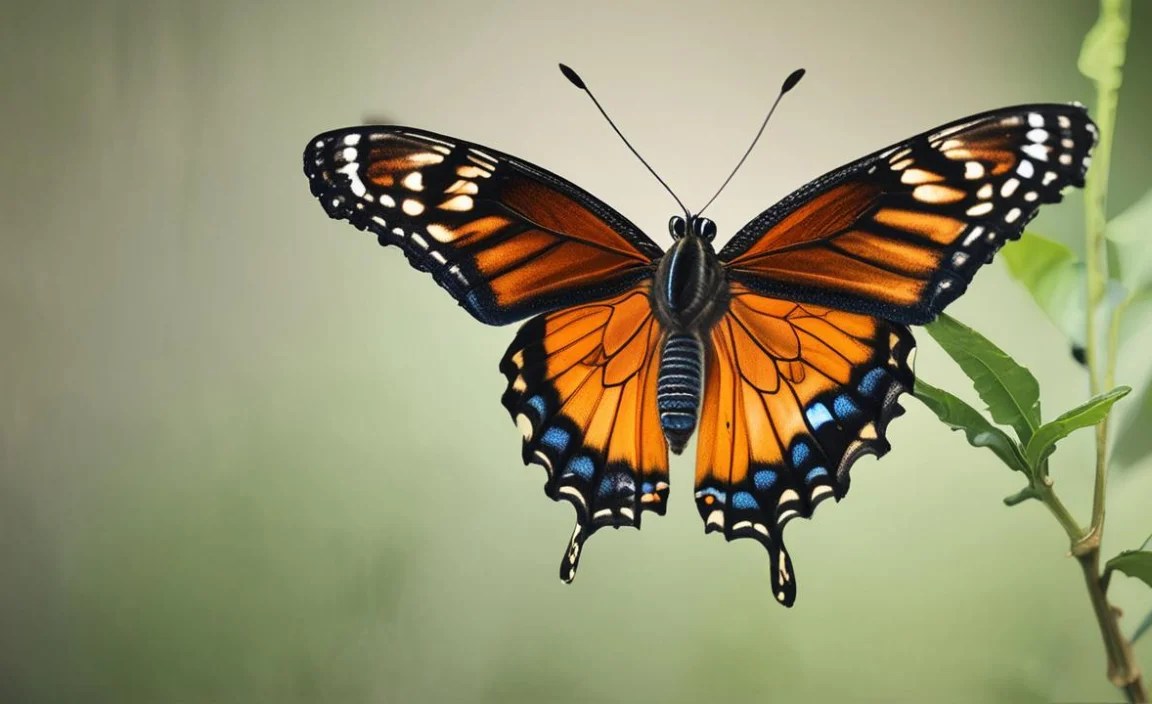
To help you further distinguish between these butterflies, here’s a table summarizing their key features:
| Butterfly Species | Size | Wing Pattern | Unique Features | Habitat |
|---|---|---|---|---|
| Monarch | Large | Bright orange with black veins and white spots | Males have black spots on hindwings | Open fields, meadows, gardens with milkweed |
| Viceroy | Medium | Orange with black veins and white spots | Black line across hindwing | Wetlands, forests, areas with willows and poplars |
| Painted Lady | Medium | Mottled orange and black with white spots | Four eyespots on hindwings | Open habitats, gardens, fields, roadsides |
| Great Spangled Fritillary | Large | Bright orange with bold black markings | Silver spots on underside of wings | Moist meadows, open woodlands, forest edges |
| Question Mark | Medium | Orange with black spots; mottled brown underside | Silver “question mark” on underside; jagged wings | Woodlands, forest edges, urban areas |
| Eastern Tiger Swallowtail | Large | Yellow with black stripes (females can be dark) | Long “tails” on hindwings | Deciduous woodlands, gardens, streamsides |
Attracting Orange and Black Butterflies to Your Garden

Want to see more of these beautiful butterflies in your backyard? Here’s how to create a butterfly-friendly garden:
- Plant Host Plants: Host plants are essential for butterfly reproduction. Monarchs need milkweed, Viceroys need willows and poplars, and Painted Ladies use various thistles and legumes.
- Provide Nectar Sources: Plant a variety of nectar-rich flowers that bloom throughout the season. Some favorites include zinnias, butterfly bushes, and coneflowers.
- Offer a Water Source: Butterflies need water. Provide a shallow dish of water with pebbles or sand for them to land on.
- Provide Shelter: Plant shrubs and trees to provide shelter from wind and predators.
- Avoid Pesticides: Pesticides can harm or kill butterflies and other beneficial insects. Choose organic gardening methods.
- Sunlight: Butterflies are cold-blooded and need sunlight to warm their bodies. Make sure your garden has plenty of sunny spots.
The Importance of Butterfly Conservation

Butterflies are not only beautiful, but they also play a crucial role in our ecosystem. They are important pollinators, helping to ensure the reproduction of many plants, including crops that we rely on for food. Unfortunately, many butterfly populations are declining due to habitat loss, pesticide use, and climate change.
Here are some ways you can help conserve butterflies:
- Create Butterfly-Friendly Habitats: Plant native host plants and nectar sources in your garden or community.
- Support Conservation Organizations: Donate to or volunteer with organizations that work to protect butterflies and their habitats, such as the Xerces Society.
- Reduce Pesticide Use: Avoid using pesticides in your garden and encourage others to do the same.
- Educate Others: Share your knowledge about butterflies and their importance with friends, family, and neighbors.
- Advocate for Conservation Policies: Support policies that protect butterfly habitats and reduce pesticide use.
Frequently Asked Questions (FAQ)
Q: What’s the easiest way to tell a Monarch from a Viceroy?
A: Look for the black line across the hindwing. Monarchs don’t have it, but Viceroys do. This is the simplest way to tell them apart!
Q: What is a host plant?
A: A host plant is a specific plant that a butterfly caterpillar needs to eat to grow and develop. For example, Monarch caterpillars only eat milkweed.
Q: Why are butterfly populations declining?
A: Habitat loss, pesticide use, and climate change are the main reasons for butterfly population declines. Protecting their habitats and reducing pesticide use can help.
Q: How can I attract more butterflies to my garden?
A: Plant nectar-rich flowers and host plants, provide a water source, offer shelter, and avoid using pesticides.
Q: Are butterflies important to the environment?
A: Yes! Butterflies are important pollinators, helping plants reproduce. They’re also a food source for birds and other animals.
Q: What should I do if I find a butterfly that looks injured?
A: If the butterfly seems injured (e.g., a damaged wing), you can offer it a sugar-water solution (one part sugar to four parts water) on a sponge or cotton ball. This can give it energy, but remember that significant injuries are often fatal.
Q: Are all orange and black butterflies poisonous?
A: No, not all orange and black butterflies are poisonous. Monarchs are poisonous to some extent because their caterpillars feed on milkweed, which contains toxins. Viceroys mimic Monarchs for protection. However, other orange and black butterflies, like Painted Ladies, are not poisonous.
Conclusion
Identifying orange and black butterflies can be a rewarding and fascinating experience. By paying attention to size, wing patterns, unique markings, habitat, and behavior, you can distinguish between different species and deepen your appreciation for these incredible insects. Remember to use field guides and online resources to aid your identification, and consider creating a butterfly-friendly garden to attract more of these beauties to your backyard.
Butterflies are not only beautiful but also play a vital role in our ecosystem. By supporting butterfly conservation efforts, we can help ensure that these delicate creatures continue to thrive for generations to come. So, get outside, observe, and enjoy the wonderful world of orange and black butterflies!


