
Species Identification of Beetles: Your Easy Guide

Have you ever seen a shiny beetle crawling in your garden? There are so many kinds of beetles! It can be tricky to know what kind you’ve found. That’s where species identification of beetles comes in handy. It helps us learn about these tiny creatures.
Imagine you are a scientist. You discover a new beetle. How would you figure out what it is? Figuring out what makes each beetle special is important. We can learn about their lives and how they help our world.
Species identification of beetles is like being a detective. You look for clues to solve a mystery. Beetles can be different colors, shapes, and sizes. Some have spots, and others have long antennas. These clues help us know their names.
Let’s learn how to become beetle experts! We will explore the amazing world of beetles. Get ready to discover their secrets. It’s like going on a mini-adventure in your backyard.
Key Takeaways
- Species identification of beetles helps us understand the huge variety of these insects.
- Look at a beetle’s size, shape, and color to help identify it correctly.
- Use tools like magnifying glasses and field guides for beetle identification.
- Learn about beetle habitats to narrow down possible species.
- Knowing beetles helps us protect nature and our gardens.
The Importance of Beetle Identification

Why should we care about species identification of beetles? Well, beetles are everywhere! They live in forests, gardens, and even deserts. They do important jobs, like breaking down dead plants. Some beetles help pollinate flowers. Others eat pests that harm our crops. Knowing which beetles are which helps us understand how they affect our world. It helps us protect the good ones and manage the ones that cause problems. When we know what beetles are around, we can keep our gardens healthy and our planet happy. Species identification of beetles is like unlocking a secret code to understand nature’s tiny helpers and sometimes, its tiny troublemakers.
- Beetles help break down dead plants.
- Some beetles pollinate flowers.
- Other beetles eat harmful pests.
- Beetle identification helps protect good beetles.
- It also helps manage harmful beetles.
- Knowing beetles keeps gardens healthy.
Think of a garden with lots of beetles. Some are eating the leaves of your favorite plants. Others are eating the tiny bugs that hurt your plants. If you know which beetles are which, you can help the good ones and protect your plants from the bad ones. Species identification of beetles is not just for scientists. It’s for anyone who wants to understand and care for the world around them. So, next time you see a beetle, take a closer look. You might be surprised at what you discover.
Why Study Beetles?
Have you ever wondered why scientists spend so much time studying beetles? It might seem like a strange hobby, but beetles are super important for our planet. They help break down dead plants and animals, which puts nutrients back into the soil. This helps new plants grow. Some beetles also eat pests that can harm our crops. By studying beetles, we can learn how to protect our environment and our food supply. Plus, there are so many different kinds of beetles! It’s like a giant puzzle waiting to be solved. Species identification of beetles is a crucial step in understanding the world around us.
Beetles and the Environment
Beetles play a big role in keeping our environment healthy. They help with things like pollination, which is when plants make seeds. They also help control pests that can damage crops and forests. When we study beetles, we can learn how to protect them and the important jobs they do. For example, some beetles are really good at cleaning up pollution. They eat harmful chemicals in the soil. By understanding species identification of beetles, we can find ways to use these beetles to help clean up our planet.
Beetles and Human Life
Did you know that beetles can actually help humans in many ways? Some beetles are used in medicine. Others are used in art. And some are even used as food in different parts of the world. Beetles can also help us learn about science. By studying how beetles have adapted to different environments, we can learn about evolution and how animals change over time. Species identification of beetles is the first step in unlocking all the secrets that these amazing insects hold.
Fun Fact or Stat: There are more species of beetles than any other type of animal on Earth! Scientists have identified over 400,000 different species.
Basic Anatomy for Beetle ID
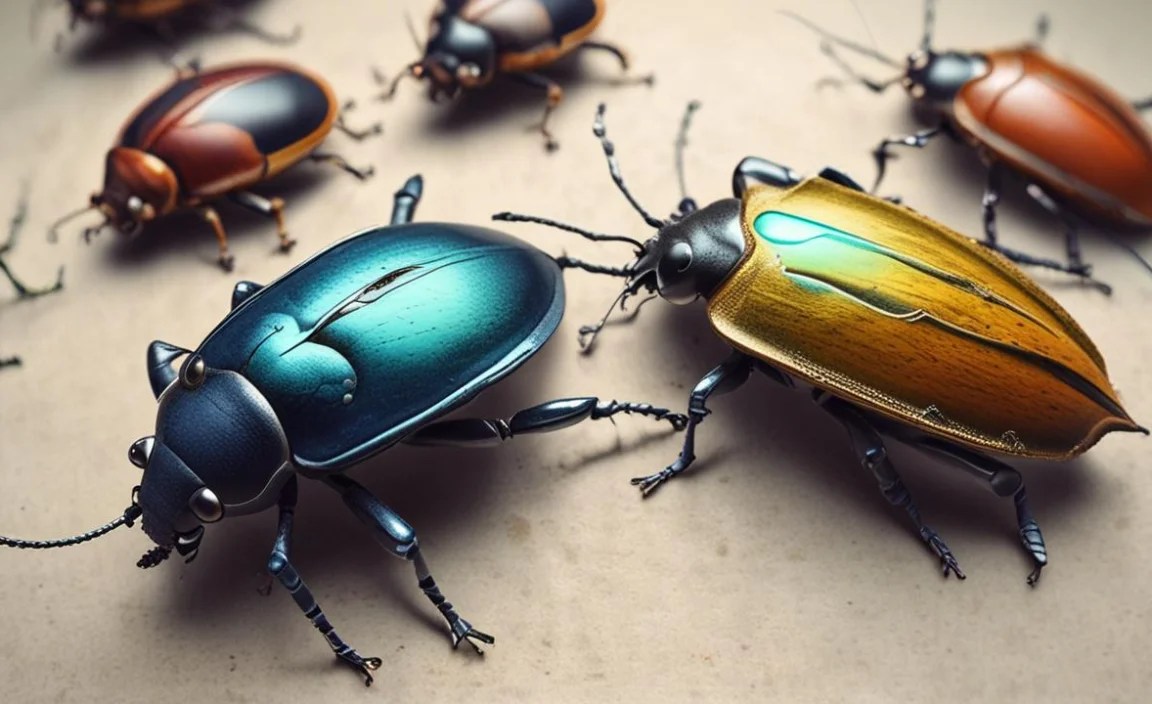
To start with species identification of beetles, you need to know their body parts. Beetles have three main parts: the head, thorax, and abdomen. The head has eyes, antennas, and mouthparts. The thorax is the middle part where the legs and wings attach. The abdomen is the back part. Beetles have a hard shell called an exoskeleton. This protects their bodies. They also have two pairs of wings. The outer wings are hard and protect the inner wings. The inner wings are used for flying. Looking at these parts can help you tell different beetles apart. Notice the shape of the head, the length of the antennas, and the color of the shell.
- Beetles have three main body parts.
- These are the head, thorax, and abdomen.
- They have a hard exoskeleton for protection.
- Beetles have two pairs of wings.
- Outer wings are hard and protective.
- Inner wings are used for flying.
Imagine you are building a model beetle. You would need to know all the parts and how they fit together. It’s the same with species identification of beetles. Knowing the basic anatomy helps you see the differences between different kinds of beetles. For example, some beetles have long antennas, while others have short ones. Some have smooth shells, while others have bumpy ones. These small differences can help you figure out what kind of beetle you have found. So, take a close look at the beetle’s body parts. You’ll be surprised at how much you can learn.
Head and Mouthparts
The head of a beetle is like its control center. It has the eyes, which help the beetle see the world around it. It also has antennas, which are like tiny sensors that help the beetle smell and feel. The mouthparts are used for eating. Some beetles have mouthparts for chewing, while others have mouthparts for sucking. The shape and size of the mouthparts can tell you a lot about what the beetle eats. For example, a beetle with strong, chewing mouthparts might eat leaves or wood. Species identification of beetles often starts with a close look at the head and its features.
Thorax and Legs
The thorax is the middle part of the beetle’s body. It’s where the legs and wings attach. Beetles have six legs, and they are usually quite strong. The legs help the beetle walk, run, and sometimes even swim. The shape and size of the legs can vary depending on the type of beetle. Some beetles have long, skinny legs for running. Others have short, thick legs for digging. The thorax is also important because it supports the wings. Beetles use their wings to fly, but not all beetles can fly. Species identification of beetles includes looking at the legs and thorax to see how they are shaped and sized.
Abdomen and Wings
The abdomen is the back part of the beetle’s body. It contains the beetle’s digestive system and reproductive organs. The abdomen is usually covered by the beetle’s wings. Beetles have two pairs of wings: the elytra and the flight wings. The elytra are the hard, outer wings that protect the beetle’s body. They don’t move during flight. The flight wings are the thin, inner wings that the beetle uses to fly. The shape and size of the wings can vary depending on the type of beetle. Species identification of beetles often involves looking at the wings to see how they are shaped and colored.
Fun Fact or Stat: Some beetles can lift up to 50 times their own weight! That’s like a person lifting a car.
Color and Pattern Variations in Beetles

Beetles come in all sorts of colors and patterns! Some are shiny and metallic, like emerald green or sapphire blue. Others are dull and earthy, like brown or black. Some have spots, stripes, or other markings. The color and pattern of a beetle can help it blend in with its surroundings. This helps it hide from predators or sneak up on prey. The color and pattern can also be a warning sign. Bright colors can tell predators that the beetle is poisonous or tastes bad. When doing species identification of beetles, always pay attention to the colors and patterns. They can be important clues.
- Beetles come in many colors.
- Some are shiny and metallic.
- Others are dull and earthy.
- Some have spots or stripes.
- Color helps them blend in.
- Bright colors warn predators.
Imagine you are painting a picture of a beetle. What colors would you use? Would you add spots or stripes? The colors and patterns of beetles are not just for show. They help the beetle survive in its environment. For example, a beetle that lives in the forest might be brown or green to blend in with the trees. A beetle that lives in the desert might be light-colored to reflect the sun. So, when you are trying to do species identification of beetles, think about where the beetle lives. This can help you narrow down the possibilities.
The Role of Pigments
Where do beetles get their colors? They get them from pigments, which are special chemicals in their bodies. Some pigments create bright, shiny colors. Others create dull, earthy colors. The type of pigment a beetle has depends on its genes. It also depends on what it eats. Some beetles get their colors from the plants they eat. The pigments in the plants get stored in the beetle’s body. This can change the beetle’s color over time. Species identification of beetles sometimes involves understanding how pigments affect a beetle’s appearance.
Camouflage and Mimicry
Some beetles use their colors and patterns to blend in with their surroundings. This is called camouflage. Camouflage helps them hide from predators or sneak up on prey. Other beetles use their colors and patterns to look like other animals. This is called mimicry. Mimicry can help them avoid predators. For example, some beetles mimic wasps. They have black and yellow stripes and fly in a similar way. This tricks predators into thinking they are wasps, which can sting. Species identification of beetles can be tricky when beetles use camouflage or mimicry.
Color Changes Over Time
Did you know that some beetles can change color over time? This can happen for a few reasons. Sometimes it’s because they are growing. As they get older, their pigments change. Other times it’s because of their environment. If they live in a different place, their diet might change. This can affect their pigments. Some beetles can even change color to match their surroundings. This helps them blend in and avoid predators. Species identification of beetles needs to consider that a beetle’s color might change over its lifetime.
Fun Fact or Stat: Some beetles can change color to match their surroundings, like a chameleon!
Size and Shape as Identification Clues

Beetles come in all sizes and shapes. Some are tiny, like a grain of rice. Others are huge, like the palm of your hand. Some are long and skinny. Others are round and plump. The size and shape of a beetle can be important clues for species identification of beetles. For example, a long, skinny beetle might be a click beetle. A round, plump beetle might be a ladybug. Pay attention to the overall shape of the beetle’s body. Is it flat or rounded? Is it long or short? These details can help you narrow down your search.
- Beetles vary in size.
- They also vary in shape.
- Size and shape are clues.
- Some are long and skinny.
- Others are round and plump.
- Shape helps narrow the search.
Imagine you are sorting blocks. You might sort them by size or shape. It’s the same with species identification of beetles. You can use size and shape to group beetles together. For example, you might put all the small, round beetles in one group. Then, you can look for other clues to figure out what kind of beetle they are. Size and shape are just the first steps. But they can help you get organized and make the identification process easier.
Measuring Beetle Size
How do you measure a beetle? You can use a ruler or a caliper. A caliper is a tool that helps you measure small objects. You should measure the beetle from its head to the tip of its abdomen. Be careful not to hurt the beetle. If you don’t want to touch it, you can take a picture of it next to a ruler. Then, you can use the picture to estimate its size. Knowing the size of a beetle is important for species identification of beetles.
Describing Beetle Shape
How do you describe a beetle’s shape? You can use words like long, short, round, oval, or flat. You can also use more specific terms. For example, some beetles are described as being “elongate” or “depressed.” Elongate means long and narrow. Depressed means flattened. Look at the beetle from different angles. This will help you get a better sense of its shape. Describing the shape is key to species identification of beetles.
Size and Shape in Different Beetle Families
Different families of beetles tend to have different sizes and shapes. For example, ground beetles are usually long and flat. This helps them run quickly on the ground. Weevils are usually small and have a long snout. This helps them feed on plants. Ladybugs are usually round and plump. This makes them easy to spot. Learning about different beetle families can help you understand the typical sizes and shapes of their members. This can make species identification of beetles easier.
Fun Fact or Stat: The smallest beetle is smaller than the period at the end of this sentence!
Using Field Guides and Keys for Identification

Field guides and identification keys are important tools for species identification of beetles. A field guide is a book that shows pictures and descriptions of different beetles. It helps you compare the beetle you found to the pictures in the book. An identification key is a series of questions that you answer about the beetle. Each answer leads you to another question. Eventually, you will arrive at the name of the beetle. Both field guides and keys can be helpful. Choose the one that you find easier to use. Remember to be patient and take your time. Beetle identification can be challenging, but it’s also rewarding.
- Field guides show pictures.
- They also have descriptions.
- Keys ask you questions.
- Answers lead to the beetle’s name.
- Both tools are helpful.
- Be patient and take your time.
Imagine you are following a treasure map. The map has clues that lead you to the treasure. A field guide or identification key is like a treasure map for species identification of beetles. It has clues that lead you to the beetle’s name. The clues might be about the beetle’s size, shape, color, or habitat. By following the clues, you can solve the mystery and discover the beetle’s identity. So, grab your field guide or key and start exploring!
Understanding Field Guide Layout
Field guides are usually organized by family or genus. Each entry includes a picture of the beetle, a description of its key features, and information about its habitat and behavior. The picture is usually the most helpful part. Compare the beetle you found to the pictures in the field guide. Look for similarities in size, shape, color, and pattern. Read the description to confirm that your beetle matches the details. Species identification of beetles becomes easier with practice using field guides.
Using Dichotomous Keys
A dichotomous key is a tool that helps you identify organisms by asking a series of questions with two choices at each step. For example, the first question might be: “Is the beetle longer than 1 cm?” If you answer yes, you go to question 2. If you answer no, you go to question 3. Each question narrows down the possibilities until you arrive at the name of the beetle. Dichotomous keys can be tricky to use at first. But with practice, they become a powerful tool for species identification of beetles.
Tips for Successful Identification
Here are some tips for successful species identification of beetles. First, make sure you have a good light source. This will help you see the details of the beetle. Second, use a magnifying glass to get a closer look. Third, take your time and be patient. Fourth, don’t be afraid to ask for help. If you are stuck, ask a teacher, a park ranger, or a beetle expert. Finally, remember to have fun! Beetle identification can be a rewarding hobby.
Fun Fact or Stat: Some field guides have information on over 1,000 different species of beetles!
Habitat and Location Clues for Beetle ID
Where a beetle lives can tell you a lot about what kind it is. Some beetles live in forests, others in deserts, and some even live in water! The type of plants and animals that live in an area can also give you clues. For example, if you find a beetle on a rose bush, it might be a Japanese beetle. If you find a beetle in a rotting log, it might be a stag beetle. When you are doing species identification of beetles, always note where you found the beetle. This can help you narrow down your search.
- Beetles live in different places.
- Some live in forests or deserts.
- Some beetles live in water.
- Plants and animals give clues.
- Note where you find beetles.
- This helps narrow your search.
Imagine you are a detective looking for a missing person. You would want to know where they were last seen. It’s the same with species identification of beetles. Knowing where you found the beetle is an important clue. For example, if you found the beetle near a pond, you can look for beetles that live in or near water. If you found the beetle on a specific type of plant, you can look for beetles that eat that plant. The location is like a piece of the puzzle that helps you solve the mystery.
Beetle Habitats: A Closer Look
Let’s take a closer look at different beetle habitats. Forest beetles often live under bark or in leaf litter. They might eat wood, leaves, or other insects. Desert beetles often live in the sand or under rocks. They might eat plants, seeds, or other insects. Aquatic beetles live in ponds, streams, or lakes. They might eat algae, plants, or other insects. Each habitat has its own unique set of beetles. Learning about these habitats can help you with species identification of beetles.
Plant Associations
Some beetles are closely associated with certain plants. This means they only live on or eat those plants. For example, the Colorado potato beetle only eats potato plants. The milkweed beetle only eats milkweed plants. If you find a beetle on a specific plant, you can look for beetles that are known to feed on that plant. Plant associations are valuable clues for species identification of beetles.
Seasonal Variations
Some beetles are only active during certain times of the year. For example, some beetles emerge in the spring to mate and lay eggs. Others are active in the summer when there are plenty of plants to eat. Still others are active in the fall when they are preparing for winter. Knowing the time of year can help you narrow down the possibilities. Species identification of beetles should consider the season.
| Habitat | Common Beetles | Food Sources |
|---|---|---|
| Forest | Ground Beetles, Stag Beetles | Insects, Wood, Leaves |
| Desert | Darkling Beetles, Scarab Beetles | Plants, Seeds, Insects |
| Aquatic | Whirligig Beetles, Diving Beetles | Algae, Plants, Insects |
| Gardens | Ladybugs, Japanese Beetles | Aphids, Plant Leaves |
Fun Fact or Stat: Some beetles can survive in extreme environments, like hot deserts or freezing mountains!
Tools and Technology for Advanced ID
Scientists use special tools for species identification of beetles. Magnifying glasses help them see small details. Microscopes let them see even smaller structures. Cameras are used to take pictures of beetles for later study. Some scientists use DNA analysis to identify beetles. This involves comparing the beetle’s DNA to a database of known species. These advanced tools can help identify even the most difficult beetles. They also help us learn more about beetle evolution and relationships.
- Magnifying glasses help see details.
- Microscopes show tiny structures.
- Cameras take pictures for study.
- DNA analysis identifies beetles.
- Advanced tools identify difficult beetles.
- They help us learn about evolution.
Imagine you are a detective with a high-tech lab. You have all the latest gadgets to help you solve crimes. Scientists use advanced tools to solve the mysteries of species identification of beetles. These tools allow them to see things that we can’t see with our eyes. They can also analyze the beetle’s DNA to determine its species. These technologies are helping us understand the world of beetles like never before.
Microscopy Techniques
Microscopy is the use of microscopes to view small objects. There are many different types of microscopy. Light microscopy uses light to illuminate the sample. Electron microscopy uses electrons to illuminate the sample. Electron microscopy can provide much higher magnification than light microscopy. This allows scientists to see the smallest details of a beetle’s anatomy. Microscopy is an essential tool for species identification of beetles.
DNA Barcoding
DNA barcoding is a technique that uses a short DNA sequence to identify species. Scientists extract DNA from the beetle and amplify a specific gene. The gene sequence is then compared to a database of known species. If the sequence matches a known species, the beetle is identified. If the sequence is new, the beetle may be a new species. DNA barcoding is a powerful tool for species identification of beetles.
Image Analysis Software
Image analysis software can help scientists measure and analyze images of beetles. The software can measure the size, shape, and color of different body parts. It can also compare images of different beetles to identify similarities and differences. Image analysis software can speed up the process of species identification of beetles and make it more accurate.
Fun Fact or Stat: Scientists can now identify beetles using just a tiny piece of their DNA!
Summary
Species identification of beetles is very important. Beetles do many jobs in our world. They help break down dead plants. Some help pollinate flowers. Others eat bad bugs that hurt plants. To identify beetles, look at their size, shape, and colors. Field guides and keys can help you learn their names. Where you find the beetle is also a clue. Scientists use special tools like microscopes and DNA to learn even more. Knowing about beetles helps us take care of our planet.
Conclusion
Beetles are fascinating creatures. They come in many shapes, sizes, and colors. Learning about them is fun and important. We can use simple clues like color and shape. We can also use tools like field guides. Advanced tools like DNA analysis help scientists. Species identification of beetles helps us understand and protect our world.
Frequently Asked Questions
Question No 1: What is the easiest way to start identifying beetles?
Answer: The easiest way to start identifying beetles is by looking at their basic features. Start with their size, shape, and color. Do they have any spots or stripes? Then, look at where you found the beetle. Was it on a plant, in the ground, or near water? These simple observations can help you narrow down the possibilities. Using a field guide with pictures is also a great way to compare your beetle to known species. Don’t be afraid to start simple and learn as you go. Species identification of beetles can be a fun and rewarding hobby!
Question No 2: What tools do I need for beetle identification?
Answer: You don’t need a lot of fancy equipment to start identifying beetles. A simple magnifying glass can help you see small details. A field guide specific to your region is very helpful. A notebook and pencil are good for taking notes and drawing sketches. If you want to take pictures, a camera or smartphone can be useful. For more advanced identification, you might consider a microscope or access to DNA analysis. However, for most beginners, a magnifying glass and field guide are all you really need. Species identification of beetles can be done with minimal tools.
Question No 3: How can I attract more beetles to my garden for easier identification?
Answer: To attract more beetles to your garden, you can plant a variety of flowers and plants that provide food and shelter. Native plants are often the best choice. Avoid using pesticides, as these can harm or kill beetles. Provide a source of water, such as a bird bath or a small pond. Leave some areas of your garden undisturbed, with leaf litter and decaying wood, as these provide habitat for many beetles. By creating a beetle-friendly environment, you’ll have more opportunities for species identification of beetles.
Question No 4: Are all beetles beneficial to the environment?
Answer: No, not all beetles are beneficial. Some beetles can be pests, damaging crops or property. However, many beetles play important roles in the ecosystem. They help pollinate flowers, break down dead plants and animals, and control populations of other insects. It’s important to remember that beetles are a diverse group, and their impact on the environment can vary greatly. Understanding species identification of beetles helps us distinguish between the helpful and harmful ones.
Question No 5: What if I can’t identify a beetle using a field guide?
Answer: If you’re having trouble identifying a beetle, there are several things you can do. First, try looking at multiple field guides or online resources. Sometimes a different picture or description can help. You can also try contacting a local expert, such as a entomologist at a university or a member of a local nature club. They may be able to help you identify the beetle or point you to additional resources. Don’t get discouraged! Species identification of beetles can be challenging, even for experts.
Question No 6: How does climate change affect beetle populations and identification efforts?
Answer: Climate change can have a significant impact on beetle populations. As temperatures rise and habitats change, some beetle species may move to new areas. This can make it more difficult to identify beetles, as species that were once rare in a particular region may become more common. Climate change can also alter the timing of beetle life cycles, making it harder to predict when they will be active. It’s important to be aware of these changes when doing species identification of beetles and to consult updated resources.


